Key Takeaways:
- Inflation has significantly increased the cost of rebuilding, repairing, or replacing business property, creating a growing underinsurance risk.
- Replacement cost is a key factor in assessing whether coverage may be adequate after a loss.
- Routine property evaluations can help identify coverage gaps before a claim occurs.
- Review business personal property regularly, as it is often undervalued.
- Central’s collaborative approach, which brings together agents, underwriters, and loss control specialists, helps support insured values being reviewed and aligned with today’s costs.
Inflation is changing what it costs to rebuild, repair, or replace business property and many businesses don’t realize their coverage hasn’t kept up until after a loss occurs.
To put this into perspective, the producer price index for key construction inputs such as steel and aluminum has risen more than 13% and 22% year-over-year, respectively, with similar increases in lumber prices. Extreme material cost inflation across the industry is not only becoming more common but also more unpredictable for contractors managing long-term projects.
These rising material prices—coupled with labor shortages, supply chain disruptions, and financing costs—have significantly increased replacement costs for buildings, equipment, and inventory.
For many businesses, the risk isn’t that inflation exists; it’s that insured property values haven’t been updated to reflect today’s costs. When coverage lags behind real-world pricing, businesses can unknowingly become underinsured, leaving critical gaps that only surface during a claim.
“That’s where routine property evaluations play a vital role,” says Patti Gundlach, commercial lines small business underwriting manager at Central Insurance. “As inflation rises, everything that goes into rebuilding a property becomes more expensive—materials, labor, financing, even insurance and repair costs. Businesses often don’t realize how much those costs have increased until they’re faced with a claim.”
Below, Gundlach explains how inflation is reshaping replacement costs and why keeping property values current is critical to supporting your business after a loss.
The Growing Risk of Small Business Property Underinsurance Due to Inflation
Underinsurance is rarely intentional. In many cases, business owners simply haven’t reviewed their property values in years. Others rely too heavily on built-in inflation guards, assuming those automatic increases are enough.
According to Gundlach, most commercial property policies include modest annual inflation adjustments, often around 5% for buildings and 3% for business personal property. While helpful, she cautions that those increases alone may not reflect real market conditions. “You need to actually review whether those increases match today’s construction and replacement costs,” she explains.
Another common misconception among small business owners involves confusing market value with replacement cost. Market value reflects what your property could sell for, influenced by land value and local real estate demand. Replacement cost reflects what it would take to rebuild the structure today.
“Just because you paid $1 million for a building doesn’t mean it costs $1 million to rebuild it,” Gundlach notes. “Those are two very different numbers.”
Learn More: Dwelling Coverage vs. Market Value: What’s the Difference?
What Is a Routine Small Business Property Evaluation?
A routine property evaluation is often called an insurance-to-value (ITV) review or replacement cost estimator. During these evaluations, small businesses and their independent agents take the time to reassess the cost to rebuild the insured property today, using current materials, labor rates, and regional pricing data.
Remember: Insurers most commonly perform small business property evaluations during an insurance renewal, but they can be done at any point during the policy term.
Agents or insurers use detailed calculators that account for all relevant factors, including building characteristics like:
- Square footage
- Construction type
- Sprinkler systems
- Internal finishes
- Elevators
- Alarms
- Geographic location
“A building in downtown Atlanta is going to have a very different replacement cost than one in a rural area,” Gundlach explains. “The estimation tools used to determine replacement cost help establish a realistic starting point.”
While replacement cost estimates are most accurate for buildings, Gundlach explains that these evaluations can also prompt important conversations about business personal property exposures. As inflation isn’t limited to construction materials, replacement costs for equipment, electronics, specialized machinery, inventory, and raw materials should also be evaluated regularly.
Learn more: Deconstructing Your Business Insurance Quote
Small Business Property Insurance and Inflation: Why Timing and Accuracy Matter More Than Ever
Gundlach recommends businesses review property values every year and, at a minimum, every two years because even short delays can create meaningful coverage gaps, especially during periods of rapid cost increases, such as those following the pandemic.
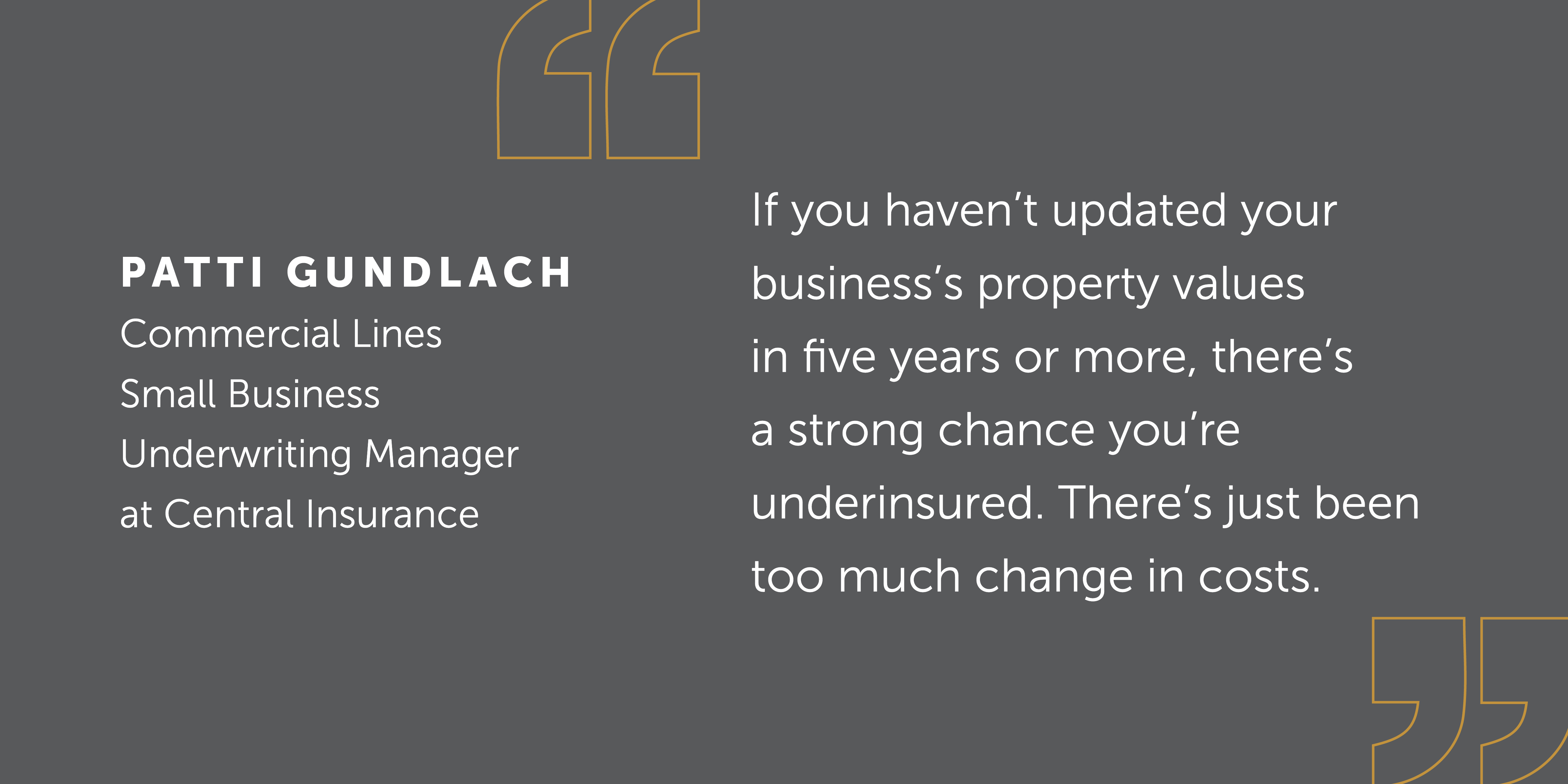
“If you haven’t updated your business’s property values in five years or more, there’s a strong chance you’re underinsured. There’s just been too much change in costs.” – Patti Gundlach, Commercial Lines Small Business Underwriting Manager at Central Insurance
Beyond scheduled reviews, businesses should reassess their values whenever they experience changes. These might include:
- The purchase of new equipment
- Expanded operations
- Rising operating costs
- Supply delays.
If your own costs are climbing, it’s often a signal that insured values may need to be adjusted mid-policy, not just at coverage renewal time.
What’s At Risk?
When property values aren’t updated, the consequences can be severe. In the event of a loss, insurance carriers can only pay up to policy limits. If those limits are too low, your business may need to absorb some or all of the difference.
“That gap can put a business in a very difficult position,” Gundlach explains. “They may not have the cash to rebuild, restock inventory, or continue paying employees.”
Additional costs, such as complying with updated building codes, ADA requirements, or sprinkler mandates, can further widen the gap if not factored into outdated valuations. Routine property evaluations help support coverage that reflects today’s realities and help businesses prepare for potential financial strain when they need coverage most.
How Central’s Loss Control and Agent Partnerships Can Protect Small Businesses From Inflation Risk
At Central Insurance, routine property evaluations aren’t treated as a paperwork exercise; they’re a proactive risk management tool built around collaboration. Loss control specialists can play a critical role in this process, particularly for accounts where inflation and operational changes may have outpaced insured values.
During on-site visits, Central’s loss control professionals can assess your building’s details, occupancy, and business personal property exposures. These reviews can uncover discrepancies caused by rising material and labor costs, added equipment, or operational changes not previously factored into coverage.
Most importantly, Central’s approach is about partnership. “We don’t dictate values,” Gundlach says. “We work together with you to make sure the numbers make sense.”
That collaboration is a key differentiator. Central’s underwriters, loss control team, and carefully selected independent agents work together to review findings, discuss assumptions, and adjust limits when needed. This collaboration helps businesses better manage the risk of underinsurance and overinsurance, which can unnecessarily inflate premiums.Routine property evaluations are among the simplest and most effective ways to support efforts to address inflation-driven coverage gaps, but only when conducted by knowledgeable professionals who understand how today’s costs affect real-world recovery. As Gundlach states, “Don’t wait until claim time to find out your values are wrong.”
Contact your local independent Central agent to discuss how you can stay ahead of inflation, reduce unpleasant surprises, and support long-term stability when it matters most.

The information provided in this blog is for informational and educational purposes only and does not constitute legal, insurance, or other professional advice. It is not intended to interpret or modify any insurance policy. Coverage may vary based on individual circumstances, policy language, endorsements, exclusions, and applicable state law.
All descriptions, summaries, or examples are general in nature and may not reflect your specific policy or coverage. No guarantee is given regarding the accuracy, completeness, or timeliness of the information. Your policy contract governs, and you should review it in its entirety to understand your actual coverage.
Nothing in this content creates a broker, agent, or advisory relationship, and you should consult your insurance professional for advice specific to your needs.
Products underwritten by Central Insurance and affiliated companies.
Copyright © 2026 Central Insurance. All rights reserved.