
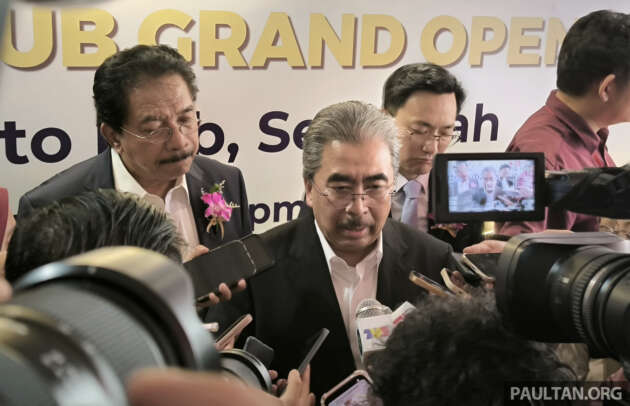
Speaking at the launch of the MCE Auto Hub in Serendah today, minister of investment, trade and industry Datuk Seri Johari Abdul Ghani said that locally assembled (CKD) vehicles’ local content must include value creation, and that the rise of CBU (fully imported) vehicles puts the supplier ecosystem in Malaysia at risk.
While the aforementioned safeguarding measures are crucial, the minister also said that the protection of the Malaysian automotive industry without permitting competition will become a liability.
“We are cognisant that that protection without competitiveness will inevitably become a liability. Industries insulated from competition rarely become global leaders, as success must come from continuous innovation,” the MITI minister said.

“This is precisely why our approach to foreign investment remains transparent. We welcome foreign automotive players to establish and expand their presence in Malaysia, to coexist and complement our domestic ecosystem,” he continued.
Whenever he is approached by an investor asking for approvals, Johari says he tells them that Malaysia is “not a place only to sell cars. We want you to come and bring all the technologies, all the components, so that you can use Malaysia as a hub,” he said.
“I can understand that no investment can give you 100% localisation on day one, but at least, after some time being here in Malaysia, we want a substantial component of car manufacturing to involve real and effective localisation,” he added.
The ministry of investment, trade and industry was accused of protectionism through its new policy for fully imported EVs that it confirmed in May. This stipulated that any EV being imported must have a minimum declared cost, insurance and freight (CIF) value of RM200,000, and a minimum power output of 180 kW (which is equivalent to 245 PS or 241 hp).
In March this year, MITI issued a statement following a news report indicating that the ministry imposed terms on BYD for its CKD local assembly plans, which the Chinese conglomerate could not agree to.
In the initial report cited, Johari stated the need to protect the local auto industry. “You must also remember that both Proton and Perodua have 50% local content in their cars, and Proton sells about 150,000 cars a year [while] Perodua sells about 350,000, which is a lot, and these two companies built much of the existing ecosystem for the auto industry in Malaysia. So, we have to protect them.”
In its response statement, MITI stated: “Together, Proton and Perodua have channelled billions into the Malaysian vendor ecosystem, supporting thousands of SMEs, skilled employees, and communities across the country. This is the industrial standard we are working to replicate.”
Looking to sell your car? Sell it with Carro.


