
The automotive industry is an unstoppable force of change and evolution, but the Toyota Camry remains the metaphorical immovable object it always has been.
Toyota’s evergreen sedan entered its current generation in late 2024 but carried over many components from the preceding iteration, albeit with improvements to practicality, power, and efficiency. There have been no changes to the current Camry since launch, either.
But even so, it remains one of Toyota’s best-selling vehicles. More than 6000 units have been sold in Australia so far in 2026, and it’s one of the few models in the Japanese brand’s portfolio to see a year-on-year sales uptick.
It’s even been Australia’s best-selling vehicle in the shrinking sedan segment in recent months, outpacing the likes of the Tesla Model 3 by a few hundred units per month and comprehensively beating others like the BYD Seal, Honda Accord, and Hyundai Sonata.
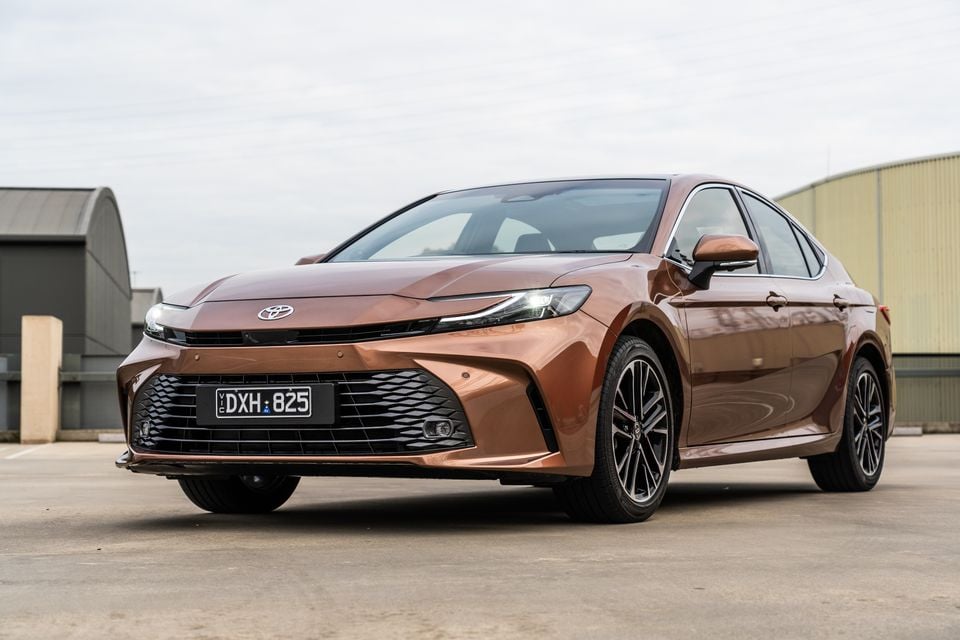
Granted, most of its sales come from Uber and taxis, but not all Camrys are destined for the rideshare game. A prime example is the 2026 Toyota Camry SL on test here, the best-equipped and most expensive Camry currently on sale. But is it worth the premium?
How much does the Toyota Camry cost?
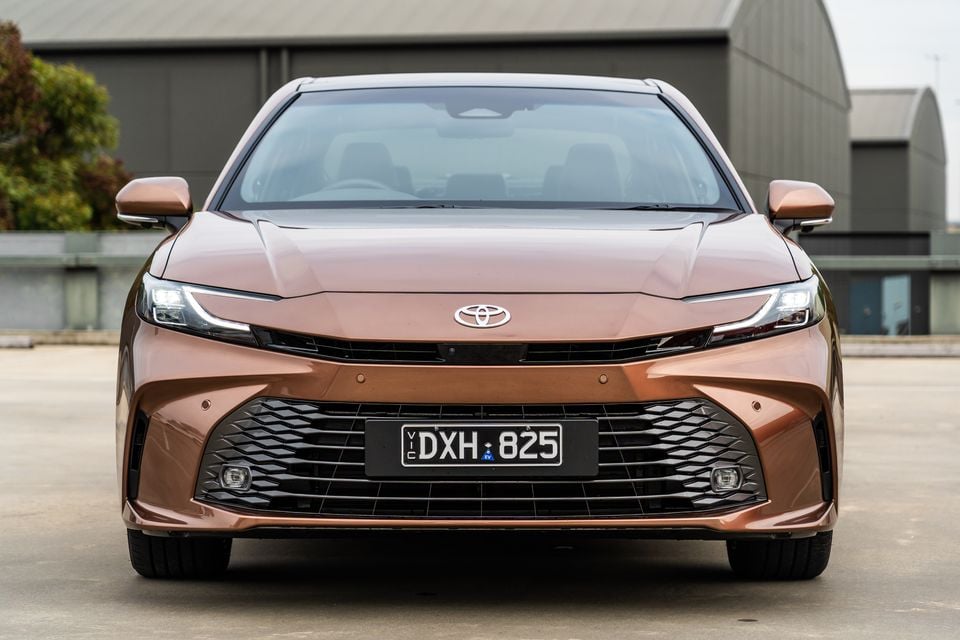
The SL sits at the very top of the Camry range, priced at $53,990 before on-road costs.
|
Model |
Price before on-road costs |
|---|---|
|
2026 Toyota Camry Ascent |
$39,990 |
|
2026 Toyota Camry Ascent Sport |
$42,990 |
|
2026 Toyota Camry SL |
$53,990 |
The cohort of Camry rivals has shrunk in recent years, though it competes with a handful of other hybrid or electric sedans. Most notable is the electric Tesla Model 3, which starts at $54,900 before on-roads but jumps to $61,900 before on-roads for the Long Range variant.
There’s also the electric BYD Seal, priced at either $46,990 or $52,990 before on-roads for non-performance models. BYD has also introduced the plug-in hybrid Seal 6, which is marginally smaller than the Camry but significantly cheaper at $34,990 before on-roads.
There’s also the Honda Accord e:HEV RS ($64,900 drive-away), the non-hybrid Hyundai Sonata N Line ($56,500 before on-roads), and, of course, the Camry-based Lexus ES (from $65,540 before on-roads).
To see how the Toyota Camry stacks up against the competition, use our comparison tool
What is the Toyota Camry like on the inside?
There’s quite a lot going on visually, but the cabin of the SL proves to be comfortable, practical, and even borderline luxurious.
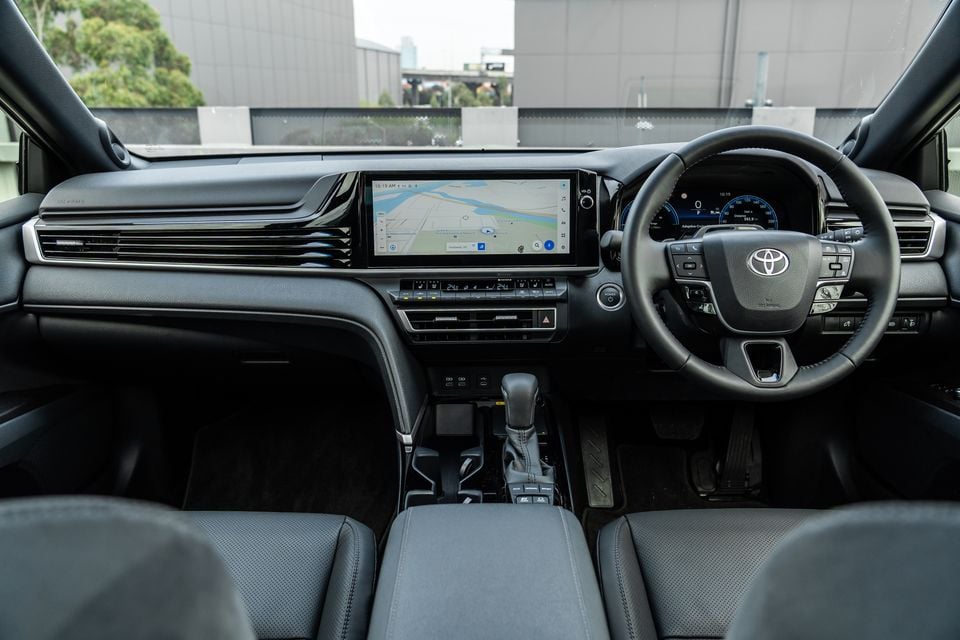
It manages to do so while remaining distinct from the undeniably plush Lexus ES, and it’s not an exaggeration to consider it one of the most premium interiors in Toyota’s entire model range. Why? Simple: material choice, functionality, and creature comforts.
Find your perfect new car with CarExpert
We’ll preface the point about materials by noting that most surfaces don’t look particularly flashy when you first hop in. The dashboard and door cards are finished in a grainy synthetic texture synonymous with cheap, scratchy plastics, and it’s difficult to shake that perception.
But once you touch and feel everything, it’s all remarkably soft. All those surfaces that look like they’d be hard and scratchy are actually padded, giving a more gentle edge to a cabin most would associate with Uber before luxury.
Naturally, there are still some scratchy plastics in high-traffic areas like the sides of the centre console and lower portions of the dashboard, but that’s hardly an issue.
It’s the key touchpoints where materials are at their best. The steering wheel, for one, is finished in lovely smooth leather that gives the driver a proper impression of ‘premium’, especially when paired with the driving experience we’ll detail later.
The SL is also the only Camry to offer powered steering wheel adjustment – something most would only associate with actual luxury brands – and two levels of wheel heating, which is all just nice to have.
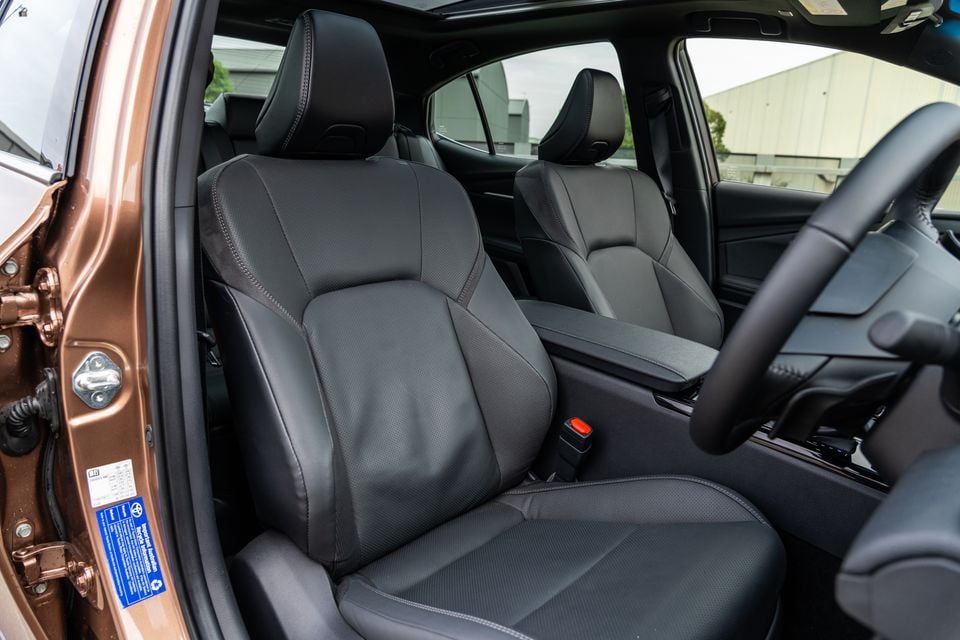
The seats, meanwhile, are very comfortable and finished in leather, though the trim on our car’s driver’s seat somehow looked stretched. They offer a broad range of powered adjustments and maintain decent bolstering without going over the top, and we enjoyed the SL’s inclusion of seat heating and ventilation.
The armrests are soft, the gear selector is finished in leather, and all interior buttons are real – no touch-sensitive nonsense to be found here. That said, we don’t necessarily love the sheer amount of buttons on the steering wheel, nor the fact that some of them are finished in piano-black plastic.
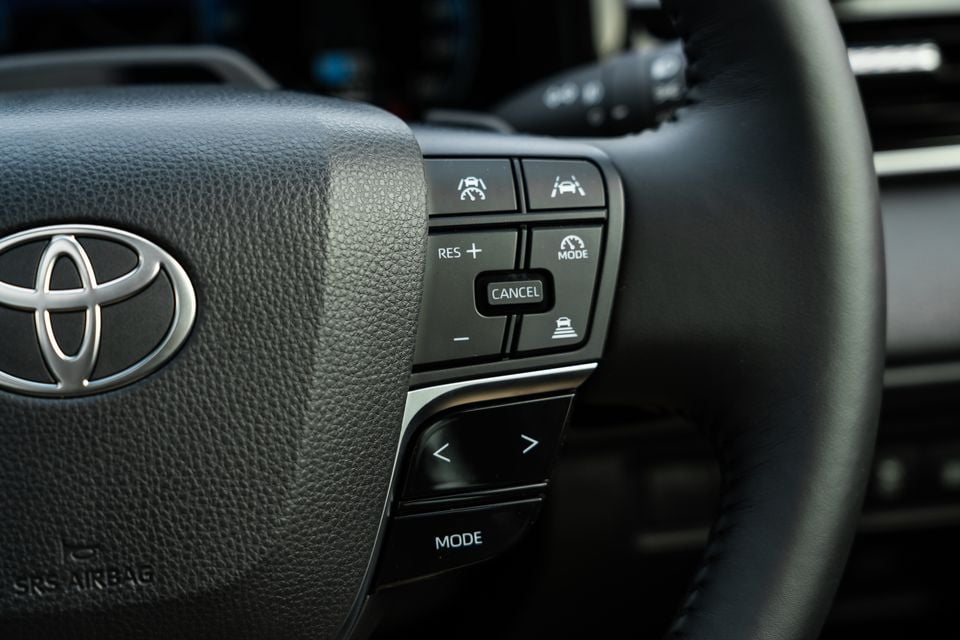
The only real downside to the Camry SL’s material palette is the liberal use of glossy black plastic. Apart from the steering wheel buttons and the top half of the climate system, there are huge slabs of it on the centre console and dashboard.
While the dashboard’s slab is an unremarkable design piece, characterised by long horizontal slats and its flow into the glossy infotainment housing, the centre console is far more egregious. Given the proximity of the gear selector, cupholders, drive mode buttons, and wireless charger, this will get scratched in no time.
It’s the only truly questionable feature in here. Everything else is impressively good, mainly because it’s so simple – just how Toyota knows how to do things. That’s more than can be said about the screen-heavy Model 3.
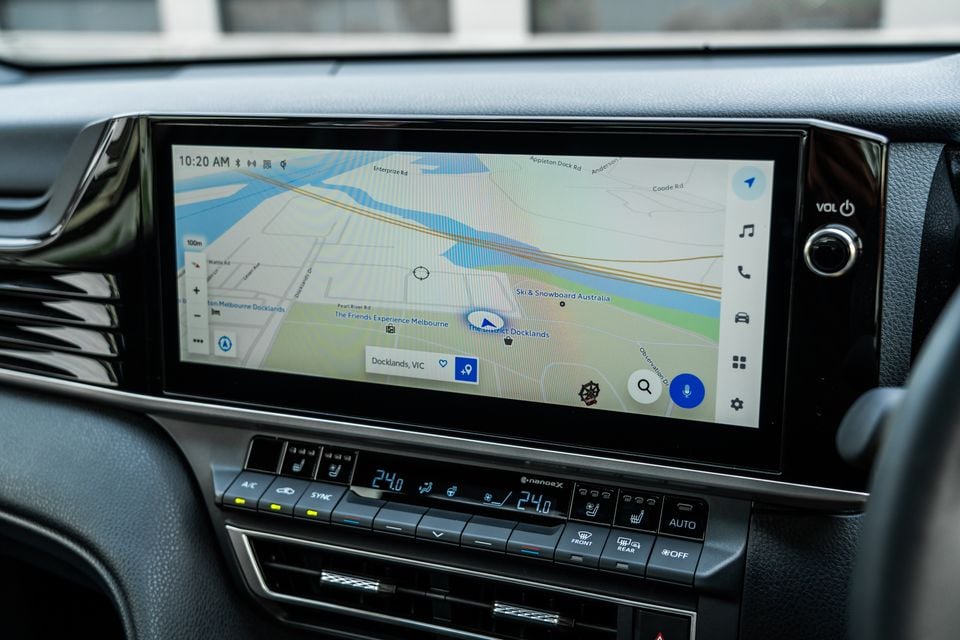
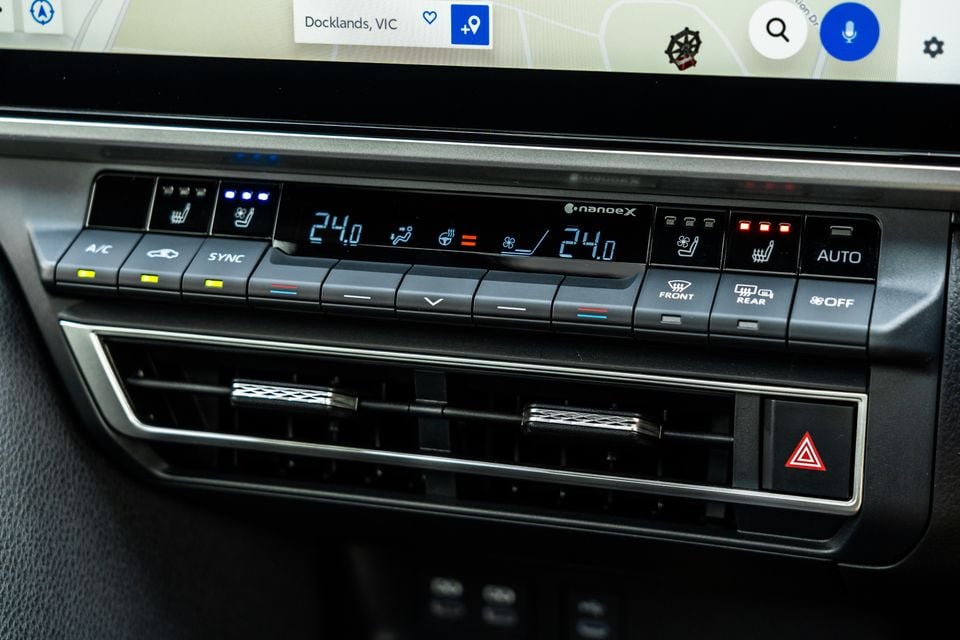
The climate system is entirely physical, takes just a moment to figure out on the move, and all buttons feel sturdy. Any changes are displayed on a simple screen, which will help newcomers to figure out what their inputs are actually doing.
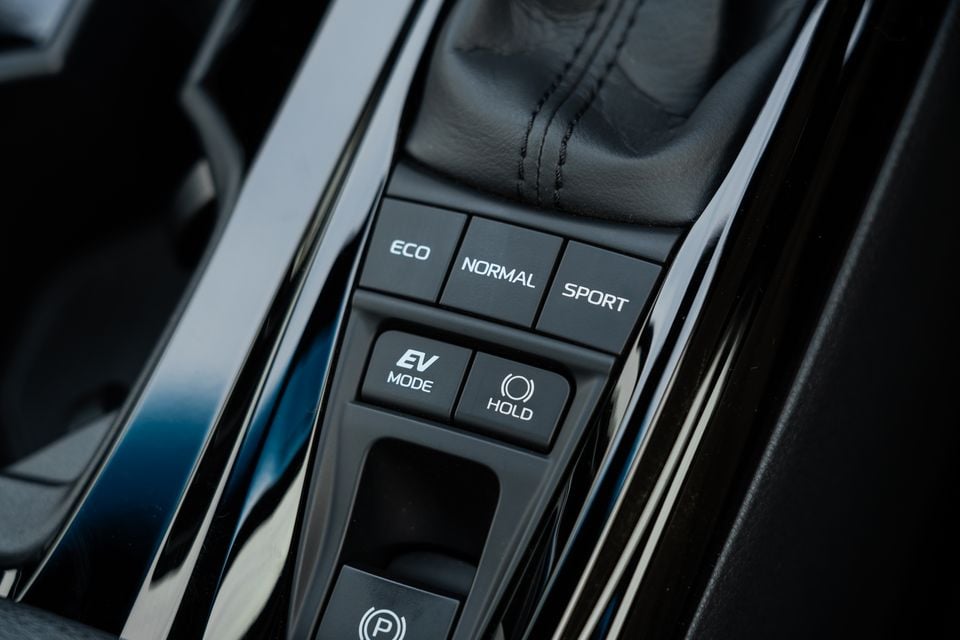
This ties into that functionality aspect. All key cabin controls fall onto physical buttons or levers, and it naturally feels familiar. It may still take you a while to fathom out the broad array of steering wheel buttons, mostly because Toyota has, as ever, crammed in as many as possible.
Invariably, it’s difficult to find things genuinely wrong with the Camry’s interior. It all just works, and does so without forcing you to first earn a degree in software development. On that note, the infotainment system is functional and tidy.
Wireless Apple CarPlay and Android Auto are standard, and we had no connectivity issues during our week with the car – three USB-C ports are below if you prefer. Vehicle settings and other native apps are accessible via a vertical shortcut ribbon, and the menus here are not overwhelmingly info-dense.
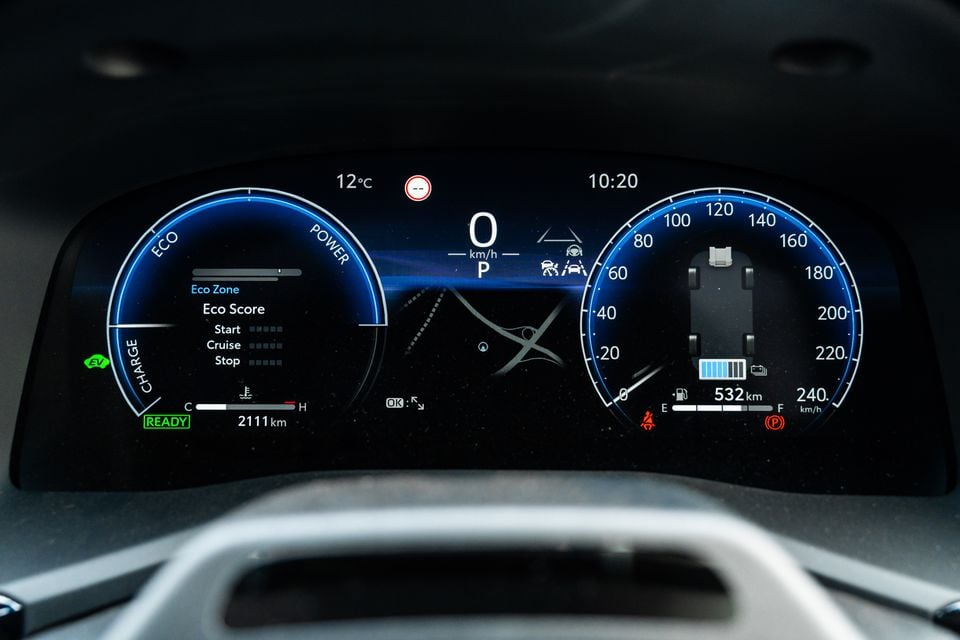
The instrument display is also crisp, though its functionality is slightly less streamlined. Its selection of layouts and information menus is navigable using steering wheel buttons, but it’s somewhat unintuitive. You won’t need to be flicking through this system, so that isn’t the end of the world.
Touching on front-row storage, the Camry is well-equipped. Cupholders and cubbies are featured on the centre console, the high-riding central armrest opens to reveal a large storage box, and under the curious swooping piece of dashboard on the passenger side is a traditional glovebox.
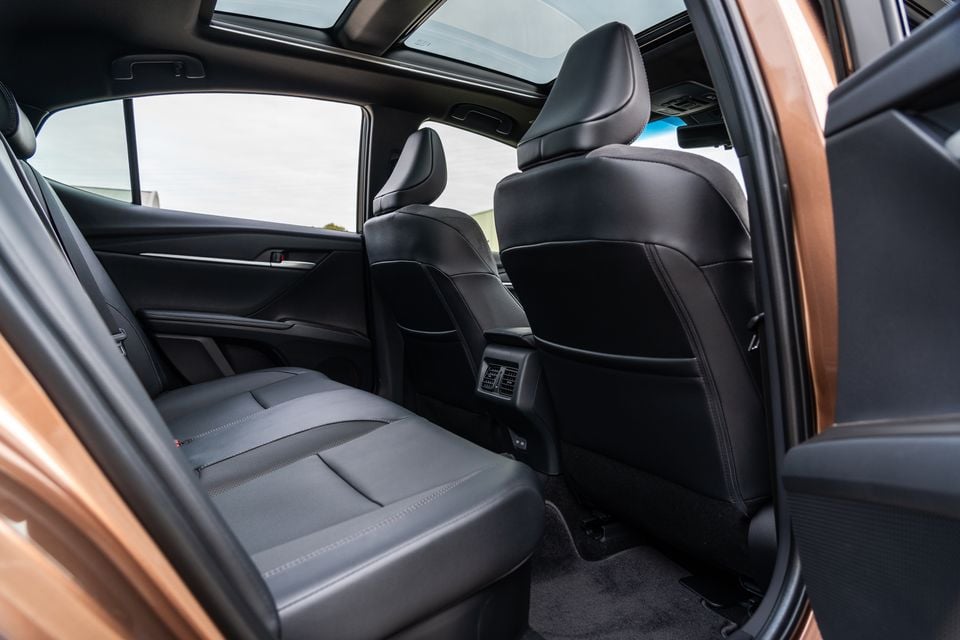
It’s worth mentioning that the cabin is generally quite compact, and nowhere is that clearer than in the second row. That isn’t surprising for a car in this segment, but it’ll still be squeezy for three adults trying to pack in side by side.
Headroom could also be better, but it isn’t horribly limiting if you aren’t any taller than 173cm. Legroom, by contrast, is decent and will remain so if the front-row occupants are also of modest stature, even if this is no long-wheelbase Lexus ES.
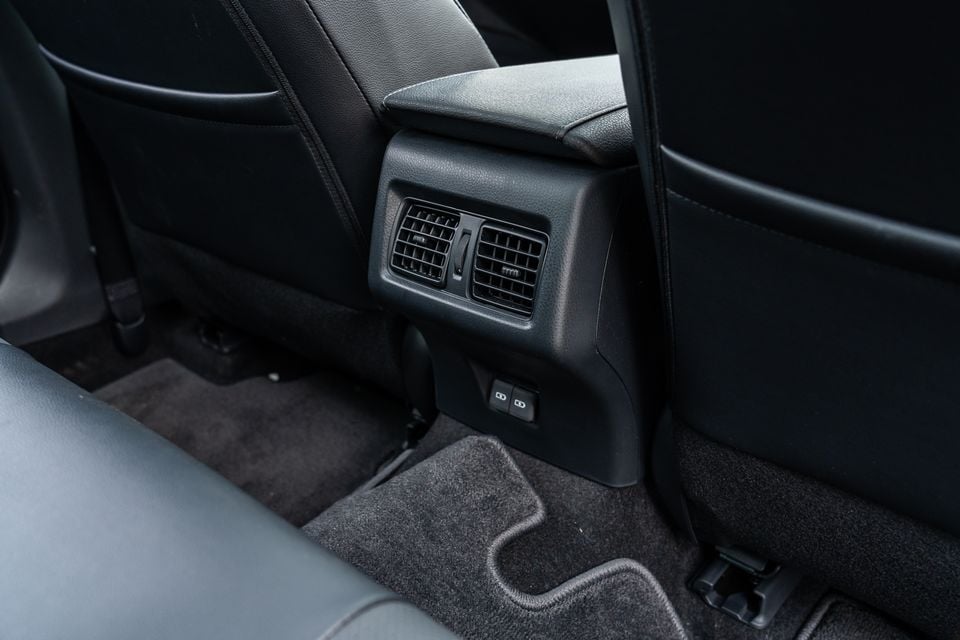
In the middle is an intrusive driveline tunnel, above which sits a pair of air vents and USB-C ports. There’s also a soft fold-down centre armrest with a pair of cupholders, map pockets on the front seatbacks, and bottle holders in the doors.
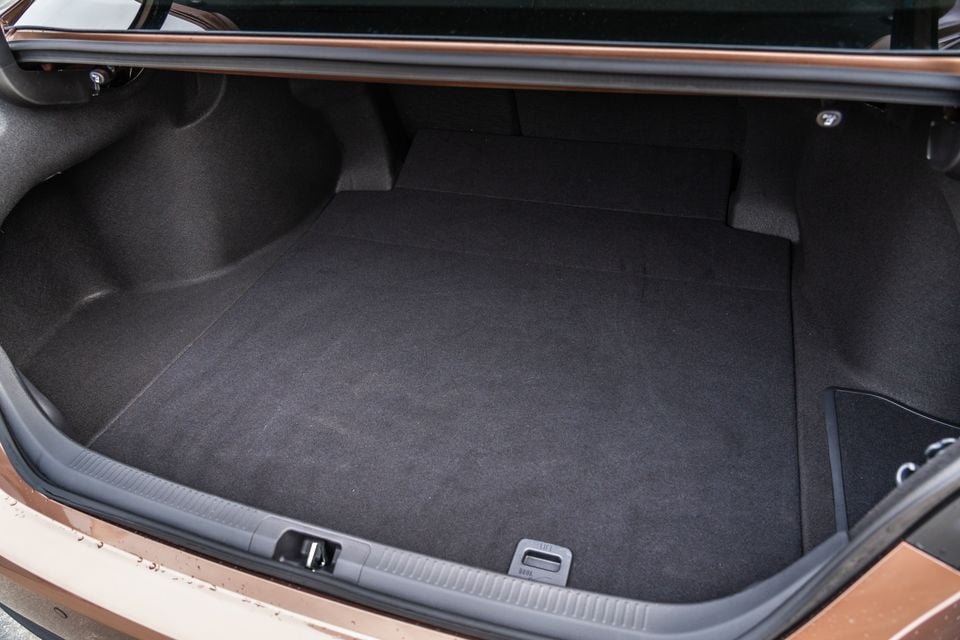
Rounding it out is an expansive boot. It’s comfortably large in true sedan form, even if Toyota’s capacity quote of 524 litres is smaller than rivals like the Honda Accord (570 litres) and Tesla Model 3 (594 litres).
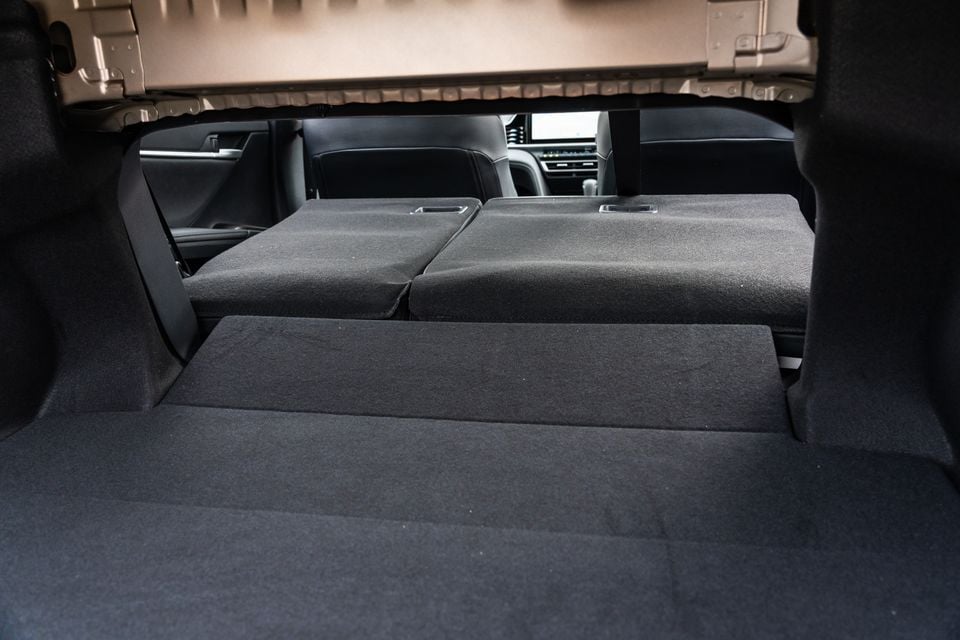
If you need more space, you can fold the rear seats down. This creates a narrow hole into the cabin, but the floor will never be completely flat, and it’s odd that there’s no middle-seat passthrough. That means you lose at least one of the outboard rear seats when transporting longer items.
Still, the Camry’s boot will be more than enough for a couple of suitcases or a load of groceries. Better yet, there’s still a space-saver spare wheel under the load floor.
|
Dimensions |
Toyota Camry SL |
|---|---|
|
Length |
4920mm |
|
Width |
1840mm |
|
Height |
1445mm |
|
Wheelbase |
2825mm |
|
Cargo capacity |
524L |
To see how the Toyota Camry stacks up against the competition, use our comparison tool
What’s under the bonnet?
Powering the Camry is a 2.5-litre non-turbo four-cylinder petrol engine paired with a hybrid system, producing up to 170kW of power – Toyota doesn’t quote a combined torque figure. Drive is sent to the front wheels via an electronic continuously variable transmission (e-CVT).
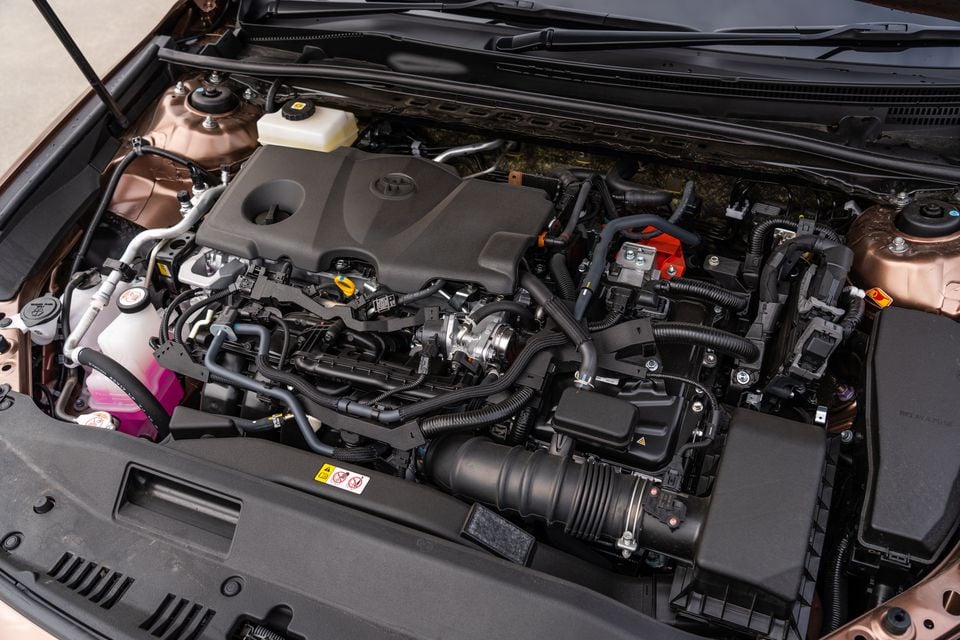
|
Specifications |
Toyota Camry SL |
|---|---|
|
Engine |
2.5L 4cyl non-turbo petrol hybrid |
|
Engine outputs |
138kW / 221Nm |
|
System outputs |
170kW |
|
Transmission |
e-CVT |
|
Drive type |
Front-wheel drive |
|
Kerb weight |
1625kg |
|
0-100km/h (claimed) |
7.2s |
|
Fuel economy (claimed) |
4.0L/100km |
|
Fuel economy (as tested) |
4.9L/100km |
|
Fuel tank capacity |
50L |
|
Fuel requirement |
95-octane premium unleaded |
|
CO2 emissions |
91g/km |
|
Emissions standard |
Euro 6 |
It’s worth pointing out that, despite its economy-car status, the Camry requires at least 95-octane fuel rather than cheaper 91-octane. This is true for all variants.
Our week with the car primarily involved commuting on both the highway and in the suburbs. That isn’t all that far detached from the habits of many Camry drivers, and while our recorded fuel economy was higher than claimed, it was still impressively low.
To see how the Toyota Camry stacks up against the competition, use our comparison tool
How does the Toyota Camry drive?
This is where the Camry really shines.
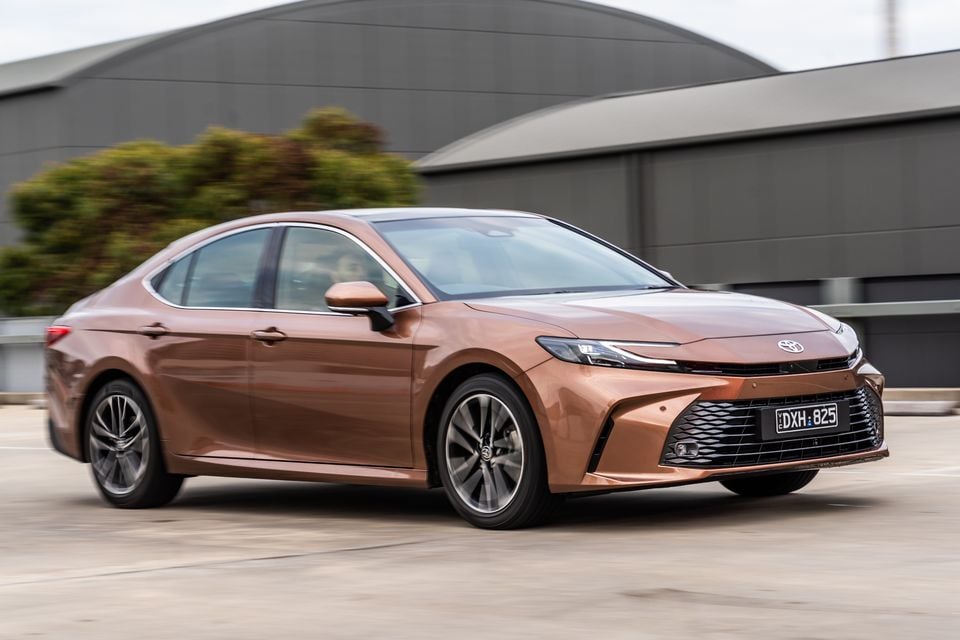
In a market dominated by hastily developed SUVs and taut ladder-frame utes, it is incredibly refreshing to hop behind the wheel of something with the proportions and characteristics of a traditional sedan like this.
You’ll immediately notice that the Camry doesn’t feel bloated in any way. Its exterior hasn’t experienced any undue growth, and its cabin is compact without feeling cramped.
That creates an excellent driving position, as you sit fairly low yet maintain a clear view of the outside world. You also have a great sense of exactly how big the car is around you, which makes it easy to place on the road.
Combine that with interior elements like the lovely steering wheel, supportive seats, and black headliner, and you have a car that is simply a joy to sit in. Once you get moving, the Camry backs that up with smooth, refined performance.
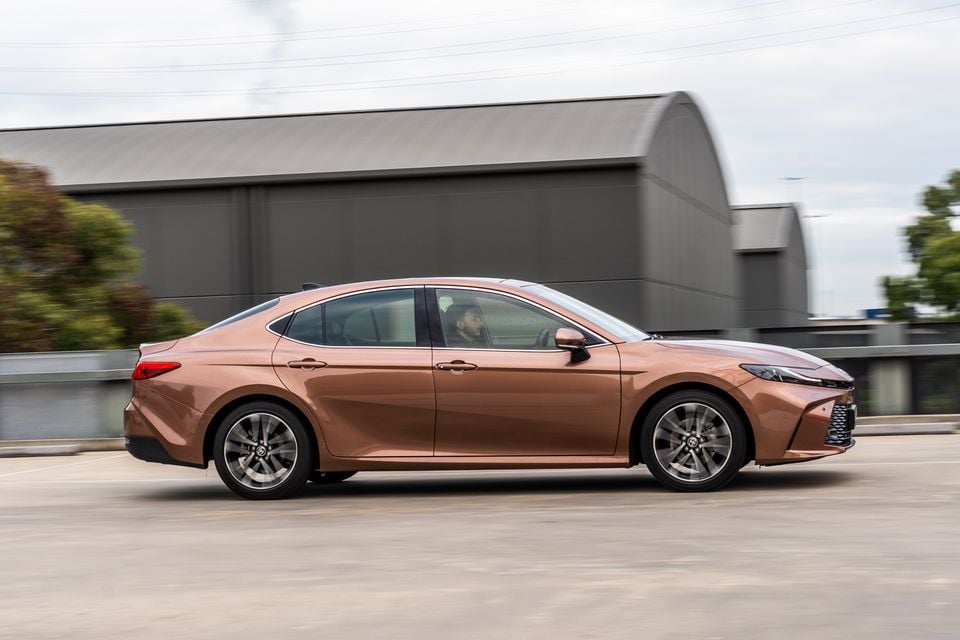
Setting off on electric power will be quiet, as expected, though there’s still enough pep if you need to get going in a hurry. Ask for more urgent acceleration and the petrol engine fires up, with the hybrid system able to deliver up to 170kW.
This power level is perfectly acceptable for a car like the Camry SL. It isn’t meant to be a sports car, but it’s more than capable of getting out of its own way with very little risk of getting the driver into any speed-related trouble.
As with every other hybrid Toyota, the switch between electric and petrol power is always seamless. More punch is available by selecting Sport mode, which sharpens throttle response and keeps the engine firing, making overtakes a breeze.
The only gripe we can reasonably raise with this powertrain is that the petrol engine can be a bit of a buzz box, especially at high RPM. It’s muffled well enough not to be a real issue, but it is audible – at least its frugal nature makes this forgivable.
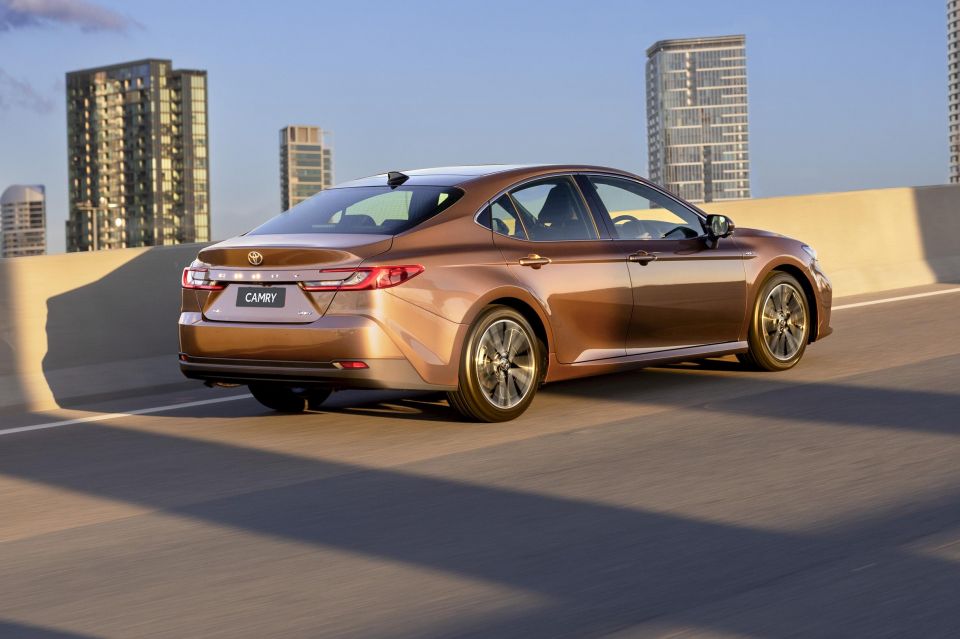
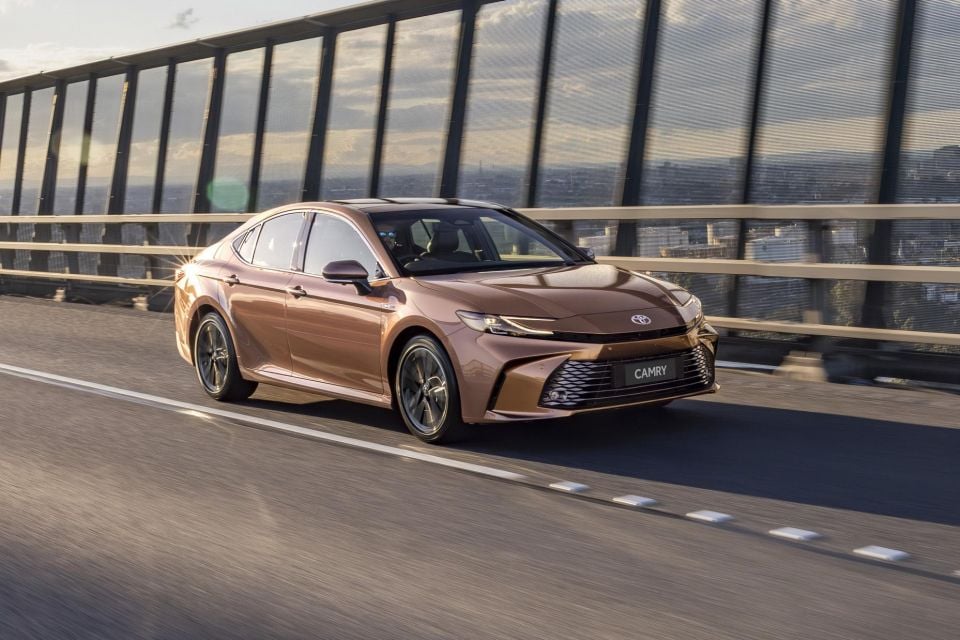
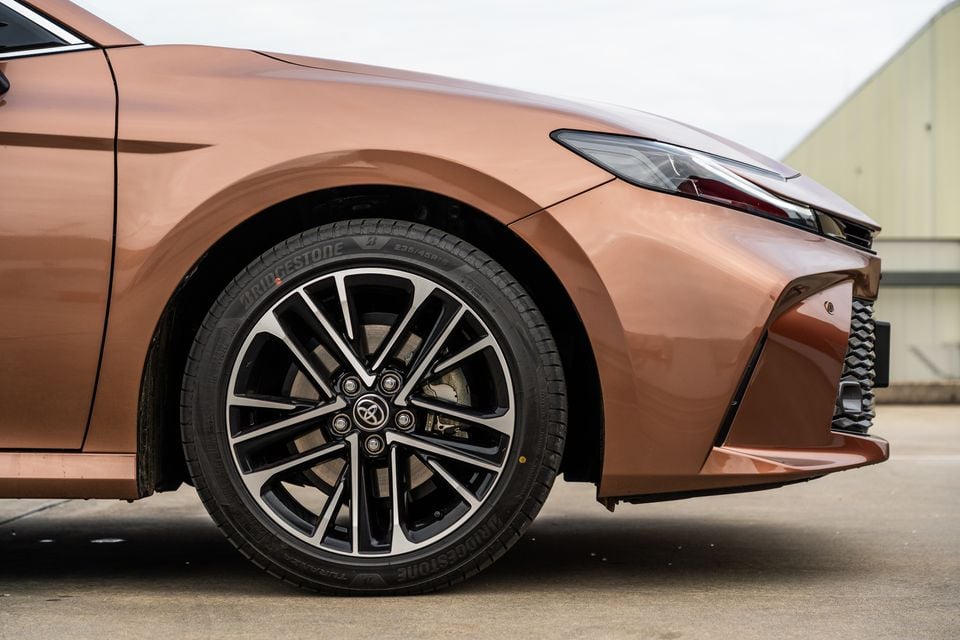
Otherwise, road and wind noise are kept to a minimum, and, for once, the larger wheels fitted to the SL don’t have nearly as significant an impact as most other large alloys. The 18-inch wheels are still fairly modest, and it means there’s just enough rubber to keep the cabin quiet while still looking the part on the outside.
Then comes ride and handling. The Camry’s ride quality exceeds its price point, thanks to a suspension damping setup that is practically perfect for the car. It glides over speed bumps and does well to mitigate smaller imperfections, with no real juddering coming into the cabin on corrugated roads.
At high speed, the car’s body settles after large bumps without a hint of bouncing, with even the roughest of sealed regional roads ironed out to good effect. This is all especially impressive when you consider that it’s been achieved without adaptive damping.
Its handling isn’t all that sharp, but the car doesn’t fall over in turns either. We found it could carry speed on a bendy road without too much fuss, but the plush suspension doesn’t lend itself to genuine corner-carving capability. For a car like the Camry, that’s totally fine.
Ready to buy? We’ll help you get a great deal.
If this is the car for you, we’ll compare offers from trusted dealers, handle the back and forth and manage your purchase from enquiry to delivery.
The steering feel, meanwhile, errs on the heavier side and gives the car substance. At no point did we struggle with anything feeling wobbly, and the gradual edge to the modest power delivery means torque steer is never really a problem.
We do find it curious that the Camry is fitted with paddle shifters when it has no gears, but they can be useful. The best application we could find was maintaining speed downhill, where a couple of ‘downshifts’ provided substantial regen/engine braking.
The cherry on top is a suite of wholly unintrusive safety gear. Unlike newer Toyotas, the Camry’s driver-monitoring camera is refreshingly relaxed, and no reactive systems like lane-keep assist ever crop up without a genuine reason to do so.
The adaptive cruise control and lane-centring are confident and reliable, and, with every other strength, the Camry is a truly effortless commuter car.
To see how the Toyota Camry stacks up against the competition, use our comparison tool
What do you get?
The Toyota Camry is available in three distinct model grades.
2026 Toyota Camry Ascent equipment highlights:
- 17-inch alloy wheels
- Space-saver spare wheel
- Auto LED headlights
- LED tail lights
- Black cloth upholstery
- Manual front seat adjustment
- 7.0-inch instrument cluster display
- 8.0-inch touchscreen infotainment system
- Wireless Apple CarPlay and Android Auto
- DAB+ digital radio
- Bluetooth
- 6-speaker sound system
- 1 x front USB-C audio port
- 2 x front USB-C charging ports
- 2 x rear USB-C ports
- Dual-zone climate control
- Toyota Connected Services – 12 months complimentary access
Camry Ascent Sport adds:
- LED fog lights
- Stainless steel scuff plates
- Leather-wrapped steering wheel
- 8-way power driver’s seat
- Driver’s seat lumbar support
- 12.3-inch touchscreen infotainment system
- Satellite navigation
- Wireless phone charger
Camry SL adds:
- 18-inch alloy wheels
- Heated side mirrors with position memory
- Rain-sensing wipers
- Auto-dimming rear-view mirror
- Power steering wheel adjustment
- Heated steering wheel
- Steering wheel paddle shifters
- Leather-accented upholstery
- Heated and ventilated front seats
- Driver’s seat position memory
- 8-way power front passenger seat
- Head-up display
- 12.3-inch digital instrument display
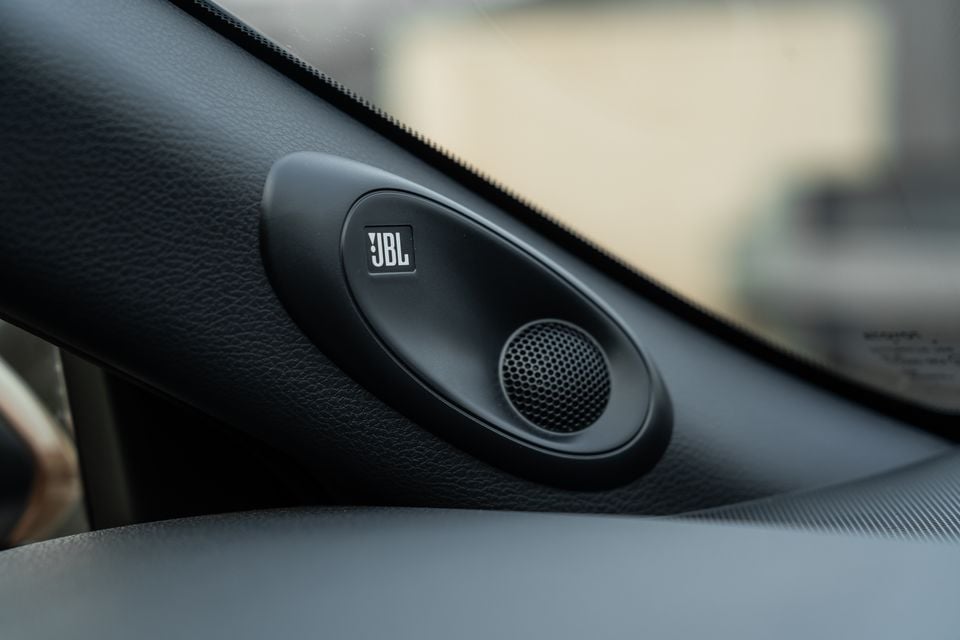
- 9-speaker JBL sound system
- Panoramic sunroof
To see how the Toyota Camry stacks up against the competition, use our comparison tool
Is the Toyota Camry safe?
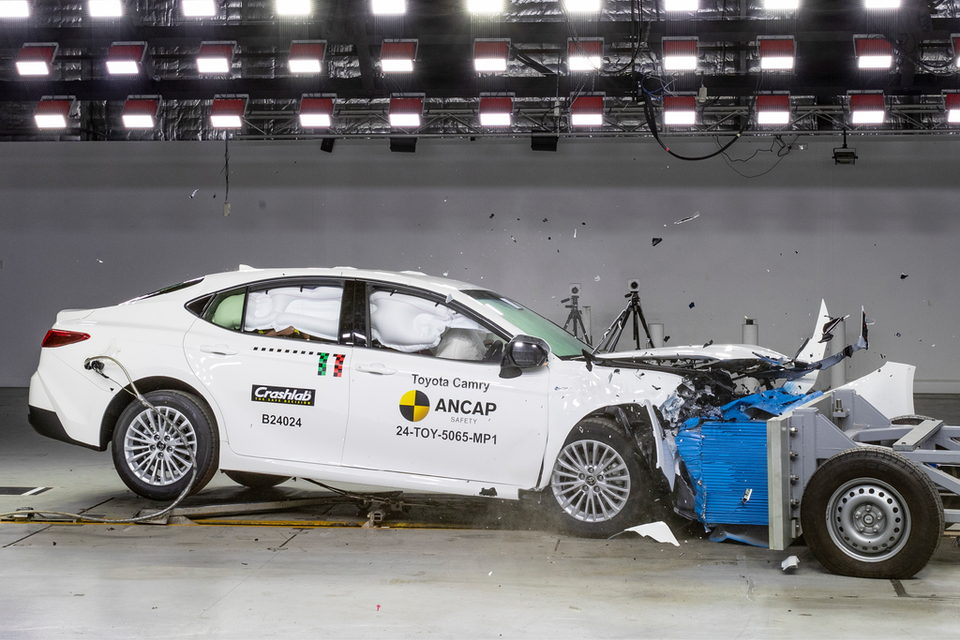
The Toyota Camry has a five-star ANCAP safety rating based on testing conducted in 2024.
|
Category |
Toyota Camry |
|---|---|
|
Adult occupant protection |
95 per cent |
|
Child occupant protection |
87 per cent |
|
Vulnerable road user protection |
84 per cent |
|
Safety assist |
81 per cent |
Standard safety equipment highlights:
- 8 airbags, incl:
-
- Front
- Front-side
- Centre
- Curtain
- Driver’s knee
- Adaptive cruise control
- Blind-spot monitoring
- Driver attention monitoring
- Emergency vehicle stop
- Front and rear parking sensors
- Lane departure warning
- Rear cross-traffic alert
- Reversing camera
- Safe exit assist
- Speed sign recognition
The Camry SL adds a surround-view monitor.
To see how the Toyota Camry stacks up against the competition, use our comparison tool
How much does the Toyota Camry cost to run?
Toyota Australia backs its range with a five-year, unlimited-kilometre warranty. Servicing for the Camry is required every 12 months or 15,000km, whichever comes first.
|
Servicing and Warranty |
Toyota Camry |
|---|---|
|
Warranty |
5 years, unlimited kilometres |
|
Roadside assistance |
Purchasable, $99 or $139 per year, depending on plan |
|
Service intervals |
12 months or 15,000km |
|
Capped-price servicing |
5 years, $275 each |
|
Total capped-price service cost |
$1375 |
Maintenance for the Camry’s direct rivals is generally more expensive. Hyundai quotes $2350 for five years of Sonata servicing, while BYD quotes $1805 for the Seal.
The exception is Honda, which offers five years of $199 services across its model range. That means five years of Accord maintenance totals just $995.
To see how the Toyota Camry stacks up against the competition, use our comparison tool
CarExpert’s Take on the Toyota Camry SL
The Camry SL is a genuinely lovely car, and its luxurious fittings do plenty to separate it from its fleet-favourite siblings.
Importantly, all those nicer inclusions don’t compromise the already-strong bones underneath. It’s still comfortable and consistently efficient, yet everything that could remind you of your most recent Uber trip has been updated with leather, soft-touch materials, and a quality sound system.
Those things make it a much more personal car. It’s not necessarily a bad thing that the Camry’s associated with rideshares either, because at least that means you fly under the radar, even if the car may not be everyone’s definition of interesting.
But the best part is that the Camry is still just a car. It isn’t trying to wow you with space-age tech, nor is it touting that it can do everything for you – everything just works.
You could say the same about cars like the Accord, but the Camry wins again in terms of value. It’s cheaper than all its direct rivals, yet it still gives off a Lexus-lite vibe. It’s simply a complete, well-rounded vehicle, and that’s increasingly uncommon these days.
They say ‘if it ain’t broke, don’t fix it’, and the Camry is exactly why.
CarExpert can save you thousands on a new Toyota Camry. Click here to get a great deal.
Click the images for the full gallery


