
[ad_1]
It’s difficult to envision a more ambitious cinematic project than an adaptation of an ancient epic like Homer’s “Odyssey” — even with the acclaimed genius of Christopher Nolan at the helm.
The staggering scale of Homer’s world, along with the challenge of directing the first feature film entirely on IMAX 70mm cameras, makes Nolan’s (“Oppenheimer,” “Interstellar”) project even more groundbreaking.
(Courtesy of Universal Pictures)
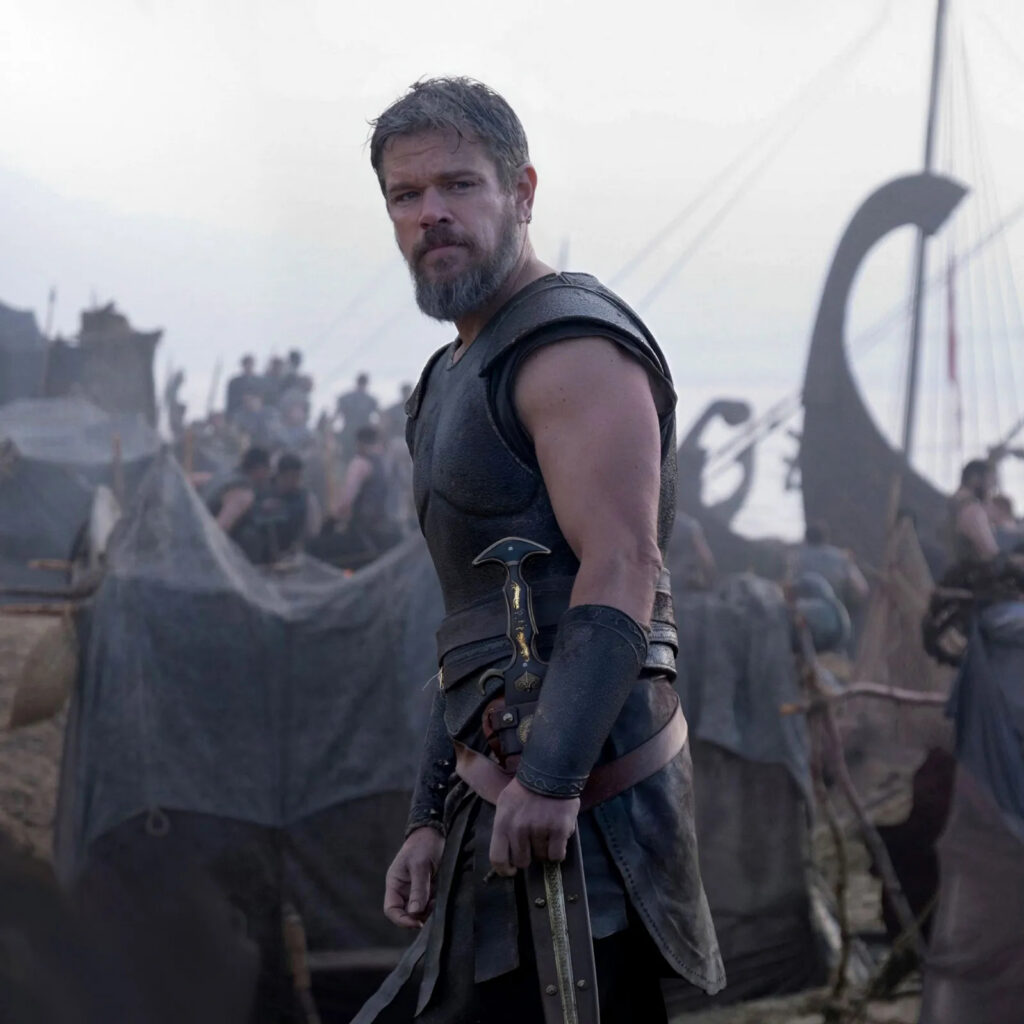
“The Odyssey” recounts the homecoming journey of Odysseus (Matt Damon), King of Ithaca, battered and bedraggled by the brutal Trojan War and a series of seemingly ceaseless divine trials.
As Odysseus struggles to make his way home, his wife Penelope (Anne Hathaway) and son Telemachus (Tom Holland) — unaware of the king’s whereabouts and desperate for his return — are tormented by Penelope’s opportunistic suitors, who routinely abuse their hospitality and strive to usurp the throne.
In a captivating, Oscar-worthy performance, Damon (“The Martian,” “The Bourne Identity”) embodies Odysseus, a hero characterized by his cleverness. The mastermind behind the Trojan Horse and a favorite of goddess Athena (Zendaya), he leads with a conviction that he can outwit anyone — including the gods.
Hathaway’s Penelope exhibits unwavering resolve and emotional strength. Her sharp intelligence and position as Odysseus’s intellectual equal, prominent features in the original text, are present but understressed in “The Odyssey.” Instead, Hathaway (“The Devil Wears Prada,” “Les Misérables”) zeros in on Penelope’s internal turmoil, her relationship with Telemachus and her adherence to Zeus’s law of hospitality.
Holland (“Spider-Man: Homecoming,” “Uncharted”) brings depth and determination to the role of Telemachus, capturing the intensity of Ithaca’s heir with soulful expressiveness.
Holland’s performance is focused and impassioned, but by the end, Telemachus appears barely more prepared for the throne than he was at the start. Even if he has matured, Nolan’s screenwriting renders a significant character arc underdeveloped.

The star-studded cast of A-listers may raise suspicions over the actors’ suitability for their roles. At times they are successful, but in other instances their performances are unremarkable.
Chief among Penelope’s sleazy and impatient suitors, Robert Pattinson is exceptional in his role as the severely degenerate Antinous.
Zendaya (“The Drama,” “Challengers”) is immaculate as Athena, goddess of wisdom and war, and guide to Odysseus. In the few minutes she graces the screen, she radiates a demanding and controlled presence marked by a palpable gravitas.
Despite the high volume of press and marketing on their behalf, the glorified cameos of Lupita Nyong’o’s Helen of Troy, Jon Bernthal’s Menelaus and Charlize Theron’s Calypso aren’t particularly impressive.
Benny Safdie’s Agamemnon is supremely commanding, but portrayed less as a character and more as a formidable symbol of Greek power.
The prominence of Homer’s “Odyssey” within the Western canon makes a comparison between the original poem and subsequent adaptations unavoidable. It’s no surprise, then, that “The Odyssey” has been enveloped in a storm of controversy since the release of its trailer, surrounding Nolan’s casting choices—some of which, such as rapper Travis Scott, do feel needlessly out of place—his reliance on Emily Wilson’s radically contemporized translation of the Ancient Greek text and the transferability of modern colloquialisms to the language of the ancient world.
But Nolan’s true Homeric unorthodoxy comes to the forefront in far more fundamental ways.
While the pain of loss, the cost of violating divine law and the danger of distraction feature as important themes, at its core, Nolan’s take conveys a message about the value of humanity, the preservation of civilization and the far-reaching impact of war — ideas that are perhaps more readily sympathized with in 21st century social and political climates.
In the aftermath of widespread imperialism and amid lawless international wars, it’s hard to imagine a modern audience rooting for a classical hero who proudly participates in the sacking of cities, engages in frequent infidelity and administers ruthless, uncompromising vengeance. Just as Homer’s Odysseus exemplifies the values of his time and place, Nolan’s Odysseus is carefully crafted for an audience in a widely different context.
In his adaptation, Nolan opts for a softer, humbler and less morally gray Odysseus, plagued with a sense of regret over his role in the Trojan War, an angrier Penelope — whose disdain for the suitors is equally as fierce as her loyalty to Odysseus — and a notably less assertive Telemachus.

(Courtesy of Universal Pictures)
The fantastical is frequently obscured as Nolan leaves out much of the myth and magic embedded in the original text. The two most noteworthy exceptions are the towering Cyclops scene, featuring the dynamic Bill Irwin, and a viscerally terrifying sequence with the witch Circe, chillingly portrayed by Samantha Morton.
Nolan weaves threads of several ancient works together in “The Odyssey” while maintaining a shifting focus on both Ithaca’s royal court and Odysseus and his crew. Narratives from Homer’s “Iliad,” Virgil’s “Aeneid” and Aeschylus’s “Oresteia” are referenced at various points, connecting Odysseus’s story to a broader mythological history.
To viewers unfamiliar with the “Odyssey”’s premise and the myths that Nolan incorporates, the vast number of characters and deep lore associated with them can be overwhelming. A richer experience of the film necessitates a basic understanding of Homer’s key characters and their relevance to Odysseus’s story.
Stunning spectacle and cinematic grandeur populate every frame, from the elaborate, immersive sets of Ithaca’s palace and Trojan fortresses to the sweeping shots of vivid picturesque landscapes. Together with a brilliant and incomparable score — composed with Bronze Age instruments by three-time Nolan collaborator Ludwig Göransson — the visually artistic elements of the film highlight the poetry of Homer’s world.
Arguably Nolan’s masterpiece, “The Odyssey” reinterprets Homer’s original and brings an increased pertinence and breathtaking artistry to the timeless epic.
“The Odyssey” is in theaters now.

[ad_2]
Source link
#Christopher #Nolan #Sails #Familiar #Shores #Odyssey


