
[ad_1]

The fish is a zarandeado dish. The method of cooking helped give the restaurant its name.
Putting modern borders aside, it’s fascinating to imagine what parts of the United States might look like if they had never been separated from Mexico. Would Texas’s cuisine—already an eclectic mix of influences—be even more vibrant? Would there be increased access to fresh food and fruit? Different trading routes? New traditions?
Rather than simply wonder, James Beard Award–winning chef Hugo Ortega decided to research the question through travel and food, letting his imagination run wild. His answer? Zaranda.
Ortega’s new Downtown restaurant, which opened in October, takes a historical and explorative look at Las Californias, an area that once encompassed what are now California (formerly, Alta California) and Mexico’s Baja California. At the core, Ortega’s vision asks: What if these regions had never been divided? “It’s kind of like you’re going back in time to when Mexico owned all of California and Baja California,” says Sophia Ortega, Hugo and Tracy Vaught’s daughter. “[You ask], What would the cuisine have been like if it just stayed under Mexican rule?” The answer combines Northern ranching culture with the rich seafood, coastal flavors, and Mexican traditions of the South, and California’s farm-to-table ethos, yielding produce like artichokes and fennel, with the warmth and depth of traditional Mexican cooking.
Though Ortega adds a playful touch to certain dishes, “the menu is not a made-up menu,” explains Vaught, who’s also co-owner of H-Town Restaurant Group. “This is how people eat in that region. It’s a unique place that has these different influences [and] that’s what made it so interesting to us.”
Zaranda’s premise builds on Ortega’s long-held beliefs that food has no borders. During his prepandemic travels, Vaught remembers Ortega posting photos with the hashtag “sin fronteras”—“without borders”—to emphasize his approach to cooking. His latest restaurant translates that philosophy into a family-style format. Sophia, who was heavily involved in creating the menu, says it was fun to categorize everything and figure out where to place items. To fit her father’s sentiment, she began the menu with para la mesa (for the table).
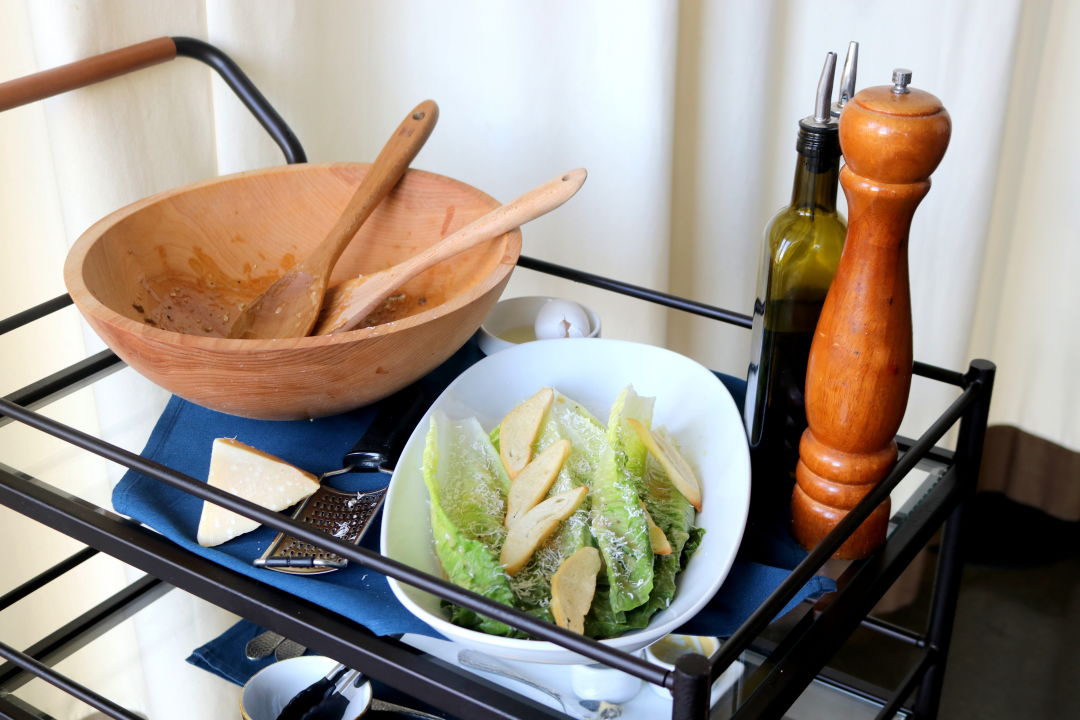
The Caesar salad can be traced back to Tijuana.
A staple Las Californias dish showcased at Zaranda is the Caesar salad. Prepared tableside, the dish’s roots trace back to the 1920s in Tijuana, where Italian immigrant Cesare Cardini famously improved his salad at his restaurant, Caesar’s Restaurante Bar, to feed diners when he ran out of ingredients. Ortega reimagines the tradition at Zaranda, where servers whisk together egg yolk, anchovies, Dijon mustard, and Parmesan, then mix in crisp romaine leaves right at the table.
At the heart of Zaranda are the zarandeado dishes, which give the restaurant its name. Inspired by years of research and fond memories of Baja California while preparing to open his Mexican coastal restaurant Caracol, Ortega says he was first drawn to this style of cooking in 2013, when, while en route to Rosarito, he witnessed a woman using the centuries-old Baja technique: cooking seafood in a zaranda, or wire basket, over an open flame. After enjoying lobster and refried pinto beans wrapped up in sobaqueras (giant flour tortillas), Ortega was intent on bringing the technique back to Houston.
Now, at Zaranda, Ortega proudly recreates that memory with octopus, whole butterflied lobster, grilled shrimp, and catches of the day, all cooked over fire and served with cucumber salad, housemade zaranda adobo, sobaqueras, and a trio of salsas. “I represent a culture, people, food, and an incredible array of ingredients, and I just am very proud to open Zaranda and offer these new flavors with all the recipes that we were able to create,” Ortega says.
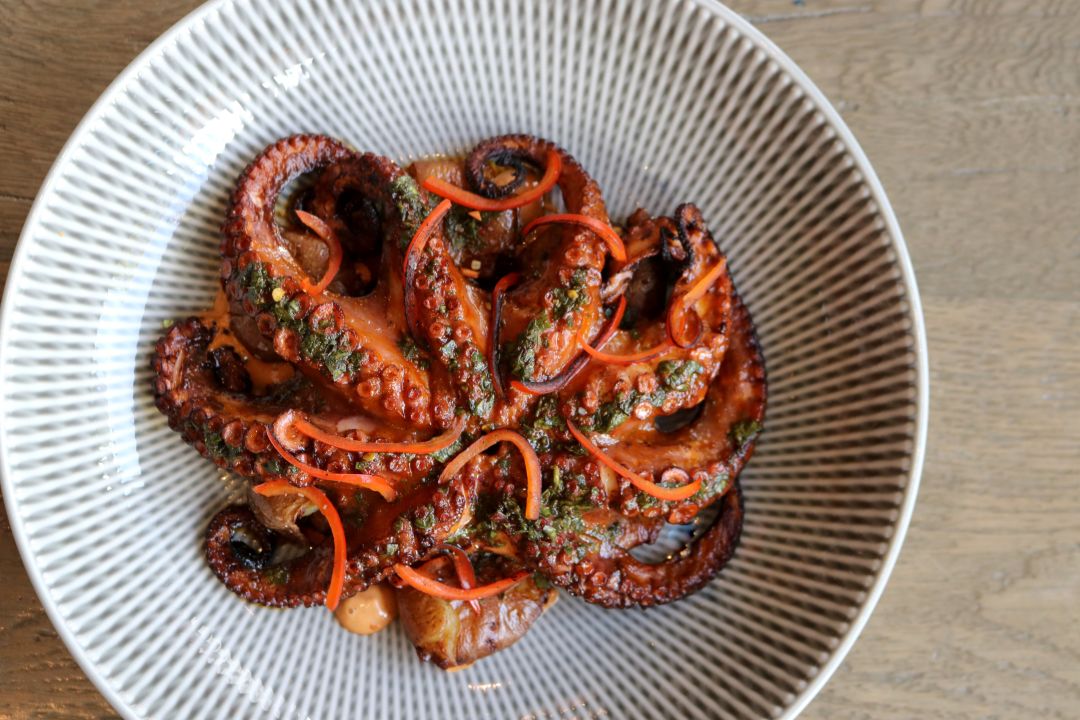
Pulpo (octopus) is cooked using the zarandeado grilling technique.
Seafood plays a starring role throughout. The conchas menu offers mussels, clams, and a variety of oyster options—all served raw, roasted, or as ostiones suaves. Ortega’s soft-shell creation features an edible shell molded from almond flour and cornstarch, filled with a raw oyster, and topped with coleslaw, lemon, smoked oyster aioli, and smoked trout roe.
Asian influences surface, too, reflecting the many contributions of Chinese and Japanese immigrants to California’s cuisine. Ortega’s taco de pato, for example, is a Mexican twist on Peking duck from Beijing, featuring tender compressed duck meat, served on a flour tortilla, finished with duck skin chicharrón for crunch; date mole, a nod to the region’s popularity with dates and a stand-in for plum sauce; and a finishing touch of cucumber and green onion.
Spanish influences, a reference to Spain’s occupation of much of the Baja area, show up in the arroces, where paellas feature Spanish bomba rice, sofrito, and white wine, combined with proteins like duck, braised rabbit, an assortment of seafood, or vegetables, including a mix of artichokes, brussels sprouts, carrots, and Mexican herb hoja santa. And in true Texas spirit, the menu wouldn’t be complete without red meat: braised lamb shank, filet mignon, rib eye, and bone-in porterhouse steak round out the offerings.

The Dólar de Arena is a white chocolate recreation of a sand dollar.
Dessert, crafted by Ortega’s executive pastry chef brother, Ruben, and lead pastry chef Roxy Puga, is both visually stunning and rich in flavors. Highlights include a white chocolate recreation of a sand dollar, a warm date cake, and a crisp macadamia-chocolate streusel cookie.
The beverages also extend the Las Californias theme, spotlighting tequila-infused drinks, including a signature margarita featuring hibiscus and pineapple, and an extensive wine list. While the California selections are familiar and prominent thanks to the massive wine region (hello, Napa Valley), the real treasures come from Baja’s burgeoning vineyards. Wine flights feature selections from Alta and Baja California, encouraging diners to taste the full range of the region and hopefully find new favorites, Sophia says.

Tracy Vaught and Hugo Ortega with their daughter, Sophia.
Like H-Town Restaurant Group’s impressive roster of restaurants, which includes Ortega’s namesake Hugo’s, Caracol, Xochi, and the soon-to-reboot Backstreet Café, each establishment, Sophia says, is built with deep intention. From the branding and design to the furniture and uniforms their servers wear, everything is backed by extensive research done not only through hours of reading, but also through travel. The hope is that each diner feels connected to the restaurant, whether through the food, drinks, or atmosphere.
“I hope that [people] see the level of research that we did [for] each concept. We’re deep thinkers. We’re always down the rabbit hole,” Sophia says. “And we hope that everyone’s going to come along with us—not just scratch the surface, but really, get immersed in the concept.”
[ad_2]
Source link

