
[ad_1]
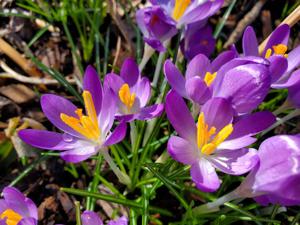
Last week, as I was scouring our backyard for signs of spring, I was pleasantly surprised to notice an inconspicuous purple flower popping up in a few isolated spots.
The tiny, solitary flower I first noticed had not opened entirely yet, but it was undeniably identified by the white strip down the middle of its slender, grass-like leaves.
It was snow crocus (Crocus sieberi).
These minute yet beautiful flowers are scattered about my lawn and garden beds across our south-facing backyard.
They seem to love to pop up in the most random and peculiar spaces blooming well ahead of anything else in the landscape.
Crocus is truly is a harbinger of spring for our yard.
So, how did this beauty of spring wind up randomly dispersed across our yard?
They have come to occupy my yard (and many others in North America) through a process called naturalization.
Although snow crocus are native to the Balkan Peninsula in Europe, our area provides a favorable climate, soils and other factors that are also excellent growing conditions for this non-native plant.
In fact, following human introduction of crocus as an ornamental plant, it has been able to reproduce naturally in much of the United States, spanning USDA Plant Hardiness Zones 3 to 8.
There are over 30 species of crocus cultivated as ornamental plants in the U.S.
By definition, naturalized plants are non-native plants that are introduced to a new geographic area and are able to grow and reproduce without human intervention, but do not threaten to overtake our native ecosystems with invasive habits.
Although they may flourish in a landscape setting, naturalized plants simply cannot compete in a more natural setting, where native plants have the advantage.
Crocus is known for its ease of naturalization in lawns and gardens, spreading though self-seeding or vegetatively underground.
Although crocus are commonly referred to as a bulb, this plant actually grows from a structure called a corm.
Corms are similar to bulbs since they are underground plant structures that are swollen with stored energy, but differ from bulbs in that they are not layered.
For comparison, consider the layers of true bulb, such as an onion.
A corm is a solid structure and does not contain the various layers that are characteristic of bulbs.
Crocuses are fairly easy to establish in your lawn or garden beds as a fall planting, similar to other bulb-like species.
They require well-drained soil and full sun to partial shade.
However, fun sun is typically abundant during their portion of the season, as trees have not leafed out.
They work wonderfully under a large shade tree, in sparse turf grass or a mulched shade bed.
The really nice thing about this plant is that it completes its annual growth relatively early in the season and allows for other plants to quickly steal the show as the growing season progresses.
Once the crocus leaves begin to yellow (in the next month or so), you can snip or mow them with no effect on the plant. They will happily come back next year for another early spring display.
While I do typically focus on native plants, I can certainly appreciate some of the early spring, non-native flowers such as crocus, daffodil and tulips.
They help to fill in with an early season of blooms in our pollinator gardens, before natives begin to wake up for the year.
I do notice an occasional pollinating insect on these blooms in the vary early season on warmer days, making a non-invasive, non-native like snow crocus a good addition in support of the early emerging pollinators.
Before too long, many of early season natives, like spring beauties or blood root, will make an appearance in our garden beds, but for now, I am content to enjoy the crocuses as we wait for the spring weather to arrive.
Ryan Pankau is horticulture extension educator with University of Illinois Extension serving Champaign, Ford, Iroquois and Vermilion counties.
[ad_2]
Source link
#Garden #blooms


