
[ad_1]
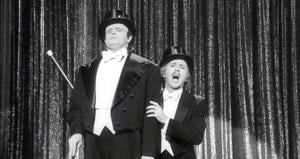
Mel Brooks had one of his earliest comedy successes as the “2,000 Year Old Man,” a crotchety witness to history interviewed by straight man Carl Reiner. And it looks like Brooks must be setting his sights on becoming the real thing: He turns 100 on Sunday. You can share in the celebrations by taking in his favorite film, 1974’s “Young Frankenstein,” as part of the News-Gazette Film Series at the Virginia Theatre at 2 p.m. on (of course) Sunday.
“Young Frankenstein” is an affectionate spoof of the 1930s Universal horror films that mixes bizarre comedy with sincere emotional content and generally appeals to viewers of all ages, even if they are not familiar with the films being spoofed.
When brilliant young scientist/neurosurgeon Frederick Frankenstein (Gene Wilder) inherits the ancestral castle in Transylvania, he finds that it comes staffed with hunchbacked lackey Igor (Marty Feldman), whose grandfather had worked for his grandfather; naïve lab assistant Inga (Terri Garr); and creepy housekeeper Frau Blucher (Cloris Leachman), whose very name sets nearby horses to whinnying and rearing.
On his first night in the castle, Frederick discovers his grandfather’s laboratory and notes on his experiments. Soon, he’s trying his own hand (or a corpse’s) at re-animating dead tissue, and yet another monster is lumbering through the village streets. But this time, Frederick uses a bit of vaudeville and a risky organic transfer procedure to give the monster (Peter Boyle) a chance to fit in to human society. That is, he would, if only his manipulative fiancée, Elizabeth (Madeline Kahn), and the local police inspector (Kenneth Mars) would leave him alone.
After starring in Brooks’ “Blazing Saddles” earlier in 1974, Wilder began working on his own screenplay based on the Universal horror films he remembered with nostalgia from his childhood. Brooks, still doing post-production work on “Blazing Saddles,” read the few pages Wilder had written and agreed to direct, figuring it would be an easier task than writing and directing his own feature. But then he became actively involved in the further writing and the negotiations with studios over the budget and his insistence that it be made in black and white to capture the feel of 1930s horror films.
Brooks and Wilder lucked out in finding the original laboratory equipment used in the early Frankenstein films (in the garage of special effects artist Ken Strickfaden, who had operated them in “Frankenstein” (1931) and “Bride of Frankenstein” (1935). And cinematographer Gerald Hirschfeld provided beautiful black-and-white images recalling the visual style of the Universal films as well as the German Expressionist classics from which that style derived.
The cast is one of the best ever assembled for a comedy, with some actors appearing for the first time in comic roles. Boyle, a Second City veteran, had already had major roles in several films, even playing the title character in a couple of them, but they were all serious villain roles. The monster ironically was his first major comedy role, though it did not mark much a change in the roles he was subsequently offered. But in the 1990s, he consistently appeared in comedies, culminating in his seven Emmy nominations for playing the father in Ray Romano’s CBS sitcom “Everybody Loves Raymond.”
Also new to comedy in “Young Frankenstein” was the actor playing the blind hermit who befriends the monster (in a scene straight out of “Bride of Frankenstein”) only to scald him and set him on fire — Danville’s own Gene Hackman. Hackman, already a major star after 1971’s “The French Connection” and 1974’s “The Conversation,” had asked Brooks for a small walk-on part and wound up with one of cinema’s more memorable cameos. He even ad-libbed his final line (“I was gonna make espresso”), and it’s become one of the film’s often-quoted lines.
Actually, many lines were improvised on the set and found their way into the final cut. Even some sight gags were ad-libbed, most notably Igor’s hump moving from one shoulder to the other. The hump was actually a prosthesis for making an actress look pregnant that was adapted to fit on Feldman’s back. As a joke on Brooks and the cast, he would shift it around during shooting; Brooks thought it was funny enough to put it in the film.
Ad-libbing often meant additional takes because the actors (and crew) kept cracking up. A particular challenge occurred in the scene where Feldman attacks Kahn’s fox stole.
“Young Frankenstein” received two Oscar nominations — for best adapted screenplay and best sound (losing to “The Godfather Part II” and “Earthquake,” respectively). It placed 13th on the American Film Institute’s list of America’s 100 Funniest Films.
Turning 100 makes Mel Brooks a literal “old GOTE” — he’s won a Grammy for “The 2000 Year Old Man in the Year 2000,” an Oscar for best screenplay for the 1967’s “The Producers,” three Tony Awards for the 2001 musical Broadway adaptation, and four Primetime Emmys. So, Happy Birthday, Mel, and keep ’em laughing.
If you go
What: The News-Gazette Film Series presents “Young Frankenstein” (1974), in honor of the 100th birthday of writer-director Mel Brooks.
When: 2 p.m. Sunday.
Where: Virginia Theatre, 203 W. Park Ave., Champaign.
Tickets: $7.
Box office: thevirginia.showare.com or 217-356-9063.
[ad_2]
Source link


