
[ad_1]
The music director’s suite at Symphony Center consists of both a traditional office with a computer and desk and an intimate room with plush charcoal-gray couches and a piano. It was in that second room that I met with Mäkelä. This was a Sunday afternoon, just a few days after I’d watched him rehearse and then, the next night, perform Mahler’s Third Symphony in concert.
Wearing a narrow-fitting black sweater and slacks, his (admittedly great) hair center-parted and tastefully coiffed, he alternated between sitting back and leaning forward, as if to pace his own thoughts about his musical past, present, and future. He had a friendly warmth to him but also a seriousness that conveyed absolute confidence in his ability to lead two world-class orchestras at such a young age; he’ll be 31 when he officially takes the reins.
Conducting at the highest level, Mäkelä told me, requires the ability to unite musicians while also challenging them. “When one plays an instrument, a cello or a violin, you decide on all the aspects of the sound. You remember how you vibrate and where you put the finger and how loud you play — everything you decide. As a conductor, the orchestra is your instrument.”
Born in Helsinki, the son of a cellist and a pianist, Mäkelä trained as a cellist himself but even as a young boy knew he wanted to make music from the podium. The seed was planted when he was 7: While performing with a children’s choir in a production of Carmen, he grew so fascinated with the conductor’s role that he tried to imitate it at home.
When he was 12, he started studying conducting with Jorma Panula at the prestigious Sibelius Academy in Helsinki. Panula taught many of the most famous Finnish conductors working today: Esa-Pekka Salonen, Susanna Mälkki, Sakari Oramo, Mikko Franck. “He was brilliant,” Mäkelä said of his mentor. “His philosophy was that less is more, and a conductor should help but not disturb.” Panula was remarkable, he added, in that “he didn’t really teach us anything concrete, so we would never learn how to do 1, 2, 3, 4 or 1, 2, 3” — beat time — “none of that.”
Instead, he taught an approach that was minimally interventionist, hewing toward fixing only what needs fixing. And he was hardly dictatorial with his instruction, preferring his pupils figure things out for themselves. Recalled Mäkelä: “If it didn’t work, he said, ‘Well, try something else.’ ”
At just 21, three years after leaving Sibelius, Mäkelä was named principal guest conductor of the well-regarded Swedish Radio Symphony Orchestra. Less than a year later, in 2018, he was appointed chief conductor designate of the Oslo Philharmonic. By the time he took over in 2020, he was garnering accolades from across the classical music world for his way with late Romantic and early modern music.
It is not hard to see how the young conductor has won over the veteran CSO musicians. The way he looks at you, the way he makes eye contact, feels imploring and urgent but in a friendly if-you-please kind of way. I have no doubt that if he wanted to start a cult, he could.
Other successes soon followed: In 2021, he started as music director of the Orchestre de Paris and became only the third conductor ever — after Georg Solti in 1948 and Riccardo Chailly in 1978 — to sign an exclusive recording contract with Decca Classics, an almost century-old premier classical label. In 2022, he was named chief conductor designate of the Royal Concertgebouw Orchestra, which he’ll take over in 2027, the same year he’ll officially start here in Chicago.
Arguably no other conductor has ever risen this far this fast. So when the CSO announced in 2024 that Mäkelä would be its new music director, it was as big a get as there is in classical music. Still, it hadn’t been a foregone conclusion that he’d land the job: The orchestra’s search committee considered other candidates, taking into account the opinions of musicians through one-on-one consultations and weekly surveys about guest conductors.
So how did the CSO settle on Mäkelä? “Each person would tell you a different story in terms of why and how we got there,” says John Hagstrom, the orchestra’s second trumpet, who was not on the search committee. “In the end, what everyone — or most people — certainly had was the same intuition, the same gut instinct, that this is a good place to get to, this is the place we want to get to again, and here’s a person who can get us there.”
Some years after the committee formed, it surveyed the full orchestra about who should be the next music director. Recalls Jeff Alexander, the president of the Chicago Symphony Orchestra Association, which administers the CSO: “The overwhelming response was Klaus Mäkelä.”
But even before that survey, Alexander had a strong feeling that Mäkelä was the person for the job. His aha moment came in April 2022, after the conductor’s first rehearsal with the orchestra, ahead of his guest debut performance of Stravinsky’s The Firebird. “I tried to go backstage to talk to him just to see how he felt it went,” Alexander recalls. “And I had trouble getting to his room because I was being stopped in the hallway by any number of musicians saying, ‘This is the guy.’ ”
Those early rehearsals also left an impression on William Buchman, the CSO’s assistant principal bassoonist. “Generally, when this orchestra sees a young person standing on the podium in front of them, they will tend to treat them with a bit of suspicion. Who’s this young person to tell me how to play this piece that I’ve been playing since before their parents were in diapers?” Buchman says. But this was different: “Klaus got up on the podium and greeted the orchestra very briefly, said it was a real honor for him to be there, and just started right in: lifted his baton and conducted us on a read-through of the entire piece.” Mäkelä did not rely on flattery to show his respect for the musicians, Buchman says: “He trusted us enough to lead us through the entire piece without saying anything about it — just communicating with his baton.”
Then there was the naturalness with which Mäkelä meshed with orchestra members outside the concert hall, including at a dinner the young conductor had with Buchman and the five other CSO musicians on the search committee. “He was just so comfortable, not trying to put on airs, not trying to withhold anything, talking not only about music but about art and culture and a little bit of politics and also not being shy about enjoying his meal in front of everybody else,” Buchman says. “Some people can be kind of reluctant to do that when they’re in a situation where they feel like they’re being evaluated.”
Still, CSO trombonist Michael Mulcahy, who was also on the search committee, was not taking any chances: He did some independent research. “I have a very good friend who is an associate concertmaster in Oslo, and I said, ‘You need to be brutally honest with me: Tell me about Klaus,’ and he said, ‘Well, I’ve known Klaus since he was kind of a teenager. This guy is the real deal.’ ”
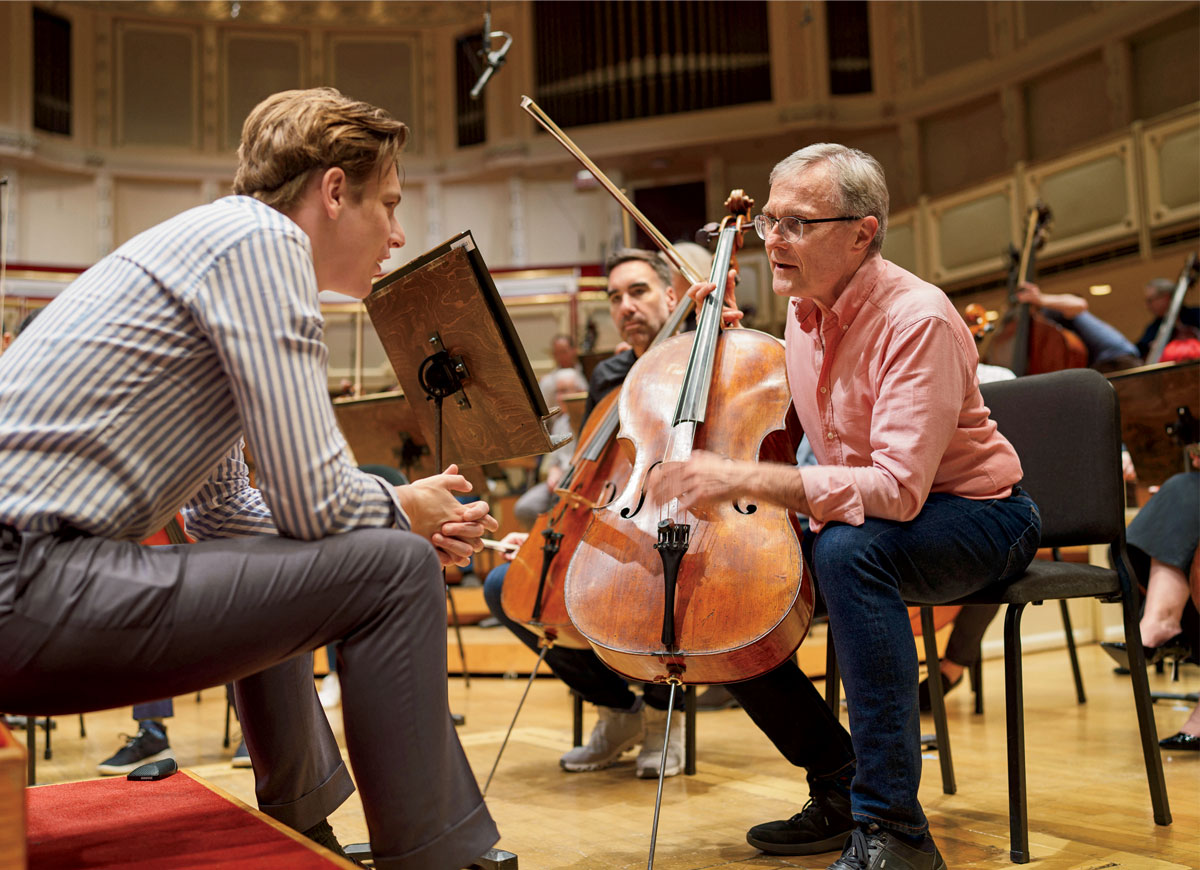
Before April, I’d seen Mäkelä perform only once, in 2023, when he conducted Mahler’s Fifth Symphony with the CSO. It was his second appearance on that podium, after the 2022 Stravinsky engagement. The Mahler concert was one of the most agile and emotionally engaged performances of that work I’ve ever heard, live or recorded — including from some of the greats, like Bernstein, Claudio Abbado, Simon Rattle, and Michael Gielen. I can still recall its extraordinary sound, especially the aching beauty of the Adagietto movement. The strings wafted up, rounded and lightly lush, hovering with a misty, crazy-making ardor. Throughout it all, it felt like the audience was holding its collective breath. It was one of those rare moments where you become acutely aware of what you’ve always known about music: that it’s a thing you hear, a thing you feel, but can never quite reach.
That was the Chicago Symphony Orchestra under — and floating above — the baton of Klaus Mäkelä. When the music rises as it did that night and becomes something profound, something real remains long after the hall has faded back to silence. It has to do with how musicians get along, how they connect to each other and to the audience. For a conductor, that can mean having soft skills like emotional intelligence as much as it can be about having a vision.
Alexander Hanna, the CSO’s principal bass, tells me that Mäkelä’s way of running rehearsals is possibly the most efficient he’s ever experienced: “A two-and-a-half-hour rehearsal goes by in what feels like 30 minutes. We accomplish so much in such a short amount of time that it makes work feel almost like a performance.” Mäkelä, says Hanna, “brings a wisdom and a feeling to the music that is well, well beyond his years.”
During the rehearsal I sat in on, I noticed how Mäkelä alternated between relaxed and pulsing energy, as he had during our interview. Sometimes he elegantly swayed; other times he leaned forward or sprang up straight like a toy soldier standing at attention. In the music’s most intense phases, he appeared composed but deeply expressive, with emphatic hand-waving and hypnotic arm movements. “Klaus has the ability to articulate what he wants,” Hagstrom says, “but he’s also sending us a lot of information visually as another layer of instruction, which is a double dose of efficiency.”
At one point, leaning on the railing of the podium, one leg hanging lightly in the air, Mäkelä talked to the orchestra about how the music must “flow.” I watched his foot dangle ever so precariously. The music must flow. I noticed later that he used the same word when talking with me about Mozart: “The music is somewhere, completely in a different sphere. It flows in a way that I believe no other music flows.”
The CSO Association president had his aha moment after Mäkelä’s first rehearsal before his guest debut. “I was being stopped in the hallway by any number of musicians saying, ‘This is the guy.’ ”
When Mihaela Ionescu, a CSO violinist, and her colleagues first worked with Mäkelä, they were stunned by his maturity: “We were sort of in shock. We had not had this kind of sincere, elegant, expert, mature approach from such a young person, and we didn’t even know, particularly, it could be possible.” Part of what she appreciates about Mäkelä stems from what his mentor, Panula, instilled in him, that a conductor should help but not disturb. Ionescu describes Mäkelä as “a kind of painter”: “He corrects colors, and he enriches here and there.”
Whatever your preferred metaphor, that Mäkelä is a brilliant artist is not in dispute. But watching him in action, I noticed that he was also an effective manager of people. When the rehearsal came to a close with the luminous, heaven-hushed Adagio movement of Mahler’s Third Symphony, some of the most exquisitely beautiful of the composer’s music, Mäkelä paused the orchestra. Holding his arms close to his chest, he spoke imploringly and deliberately of how this is lofty, heavenly music, and that it must be handled as such.
“Just play,” he told the orchestra. “Don’t do anything.”
His talent as a conductor doesn’t translate so easily into terms critics enjoy, such as “interpretive voice.” Rather, his is a management style predicated on trust and communication and mutual respect — and the music flows in part from that. Mäkelä, says trombonist Mulcahy, “knows that the orchestra is very reliable, and so he is looking at how the music could affect the playing of the players, where the music actually emotionally moves them in that moment to do something special.”
When I asked Mäkelä about this, he compared conducting to managing a business: “If you run a company, if you just do exactly how you want and you don’t listen to any other people, then the result can’t be very good. After all, I work with the hundred best people in the country, or quite possibly in the world, so it’s clever to listen.”
I was curious, apprehensive even, to see if the cohesion achieved in rehearsal would survive the rigorous demands of performing Mahler 3 in concert.
With a children’s chorus, a women’s chorus, and around a hundred musicians arrayed in front of him, Mäkelä took the podium that next night for more than 90 minutes of music that began with the epic first movement, where, as Mahler once noted, “Pan awakes” and “summer comes marching in.” The lilting second movement was so sonically aromatic I could have sneezed. By the time the orchestra reached the finale — transcendent music that descends, then ascends, with you wrapped, or perhaps rapt, in it — I couldn’t quite believe how much the players seemed to heed Mäkelä’s paradoxical direction: Just play. Don’t do anything.
[ad_2]
Source link
#Age #Klaus #Mäkelä


