
[ad_1]
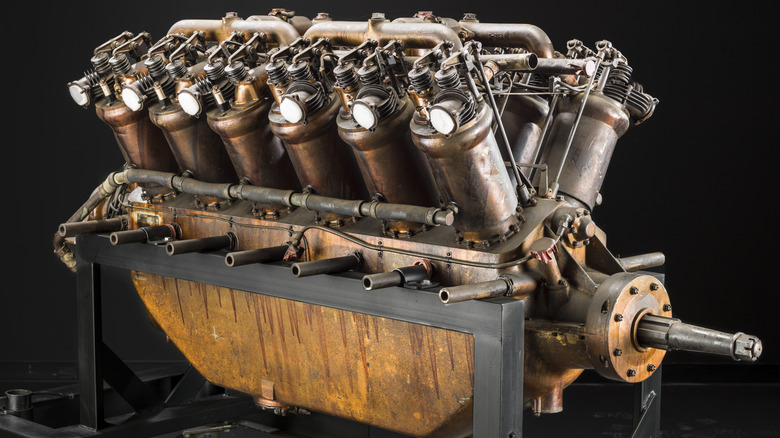
Some of the world’s most fascinating engineering designs didn’t come from corporate design rooms with inspiration boards and cute espresso machines. Many came from impromptu sparks of genius, such as the Bugatti Veyron’s W16 engine, which was originally drawn on an envelope by Ferdinand Piech. Others come out of necessity, such as the Liberty V12.
Deemed one of the most important engines to ever come out of America, the Liberty V12 was initially designed in a hotel room, and went on to help the Allied forces in World War I. It also helped form a car company that still exists today – Lincoln. In fact, the company was founded purely to build the engine for the United States military, and it continued to supply aircraft engines to the Allied war effort. So, without an engine designed in a hotel room, Ford’s luxury automotive division wouldn’t have existed today.
Why was the Liberty V12 designed in a hotel room?
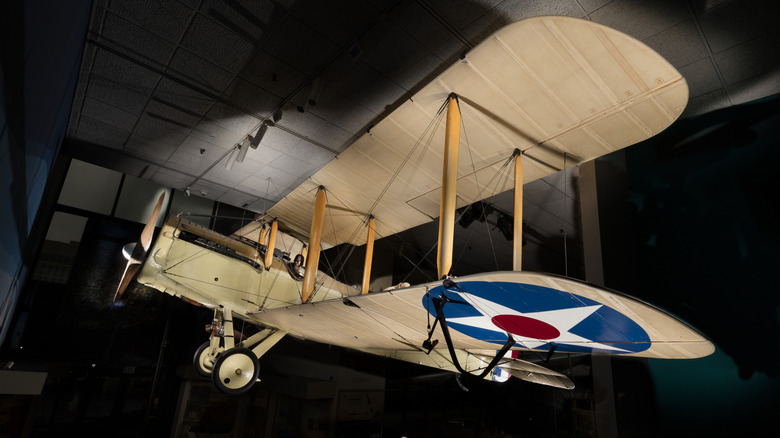
In 1917, after the U.S. declared war on Germany, President Woodrow Wilson promised 11,000 planes to the war effort. However, to build those planes fast enough, a simple, modular engine design was needed to streamline production. Congress created the Aircraft Production Board on May 16, 1917, with Howard E. Coffin — engineer and co-founder of the Hudson Motor Car Company — at the helm. Coffin assembled a squad of two to develop an aircraft engine that would be lighter and more powerful than the Rolls-Royce Eagle but cheaper and faster to manufacture.
The engineering duo of Elbert J. Hall — founder of California-based engine manufacturer Hall-Scott — and Packard’s head of engineering Jesse G. Vincent were given a few days at the New Willard hotel in Washington, D.C. to come up with an engine design. What they came up with was an engine that was heavily inspired by both one of Packard’s racing engines and the French Lorraine-Dietrich aircraft V8.
Hall and Vincent’s original engine was also a V8, but their plans said the engine could be scaled anywhere from four cylinders all the way up to 12. The latter was chosen as the standard engine due to its superior power, so the Liberty 12 Model A V12 (also known as the L-12) was born in 1918, with a 27-liter displacement and pushing 400 horsepower at 1,800 rpm. Later that year, a Turbo-supercharged version was made using a GE-sourced supercharger that bumped it to 449 horsepower at 1,940 rpm. British-built Havilland DH-4s fitted with this engine were dubbed “Liberty Planes.”
What does a WWI aircraft V12 have to do with Lincoln?
So what does this have to do with Lincoln? Well, like with many military industrial projects, the United States government looked to automakers to build the Liberty V12. Ford, Packard, and General Motors were among the companies approached to build L-12 engines, but GM initially declined because the company president, William C. Durant refused to participate in the war effort. However, Henry Leland, the founder of Cadillac, wanted to help, so he left GM and founded Lincoln with the help of a massive $10 million (over $284 million in today’s dollars) contract to build Liberty engines.
About a year later, Armistice Day ended World War I, so Lincoln needed something else to do aside from building engines for the war. In 1920, the company built its first car — the Model L — powered by the L-head V8, but despite producing an impressive 71 hp, it didn’t sell very well. Lincoln was in financial trouble, so Ford swooped in and bought it for $8 million. Although Leland was unhappy with the sale, he left the company a few months later and sued Ford.
[ad_2]
Source link

