
[ad_1]
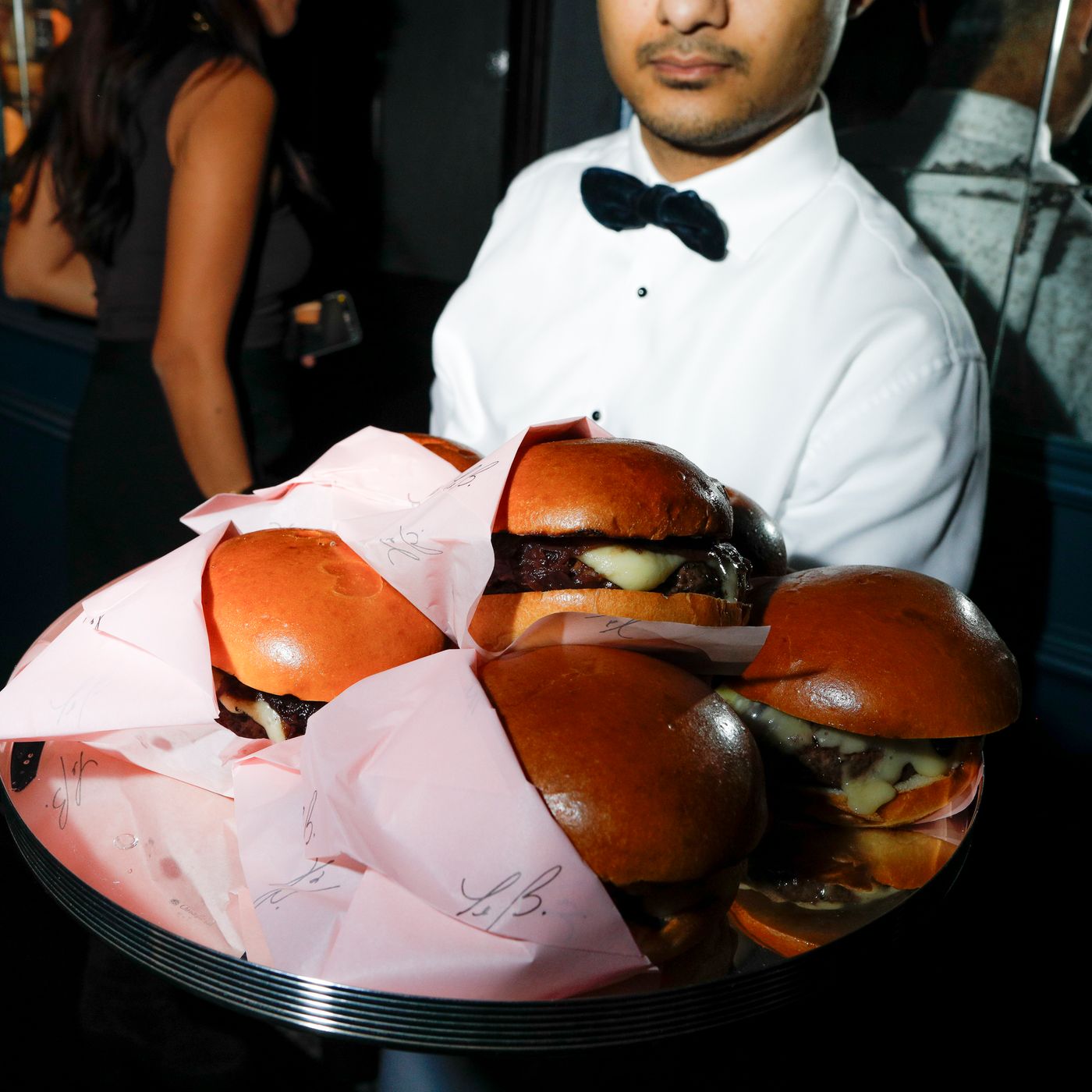
Les Burgers at Le B.
Photo: Mike Vitelli
There are good reasons no one puts burgers into time capsules. If they could, there’d be few foodstuffs that more accurately oozed the juices of their particular moments. To reference the DB Bistro Moderne foie burger to one who was there or the preeminence of the Shake Shack Shackburger in that prelapsarian moment where getting one required an hour-long wait in Madison Square Park — before these memories, the madeleine crumbles. Of course, status burgers have both elevated and aggravated chefs for as long as they’ve been griddling them. Like a sesame-seeded eclipse, a famous burger can cast the rest of a chef’s creations into the shade.
Two of the great status burgers of the twenty-teens belonged to Angie Mar, then at the Beatrice Inn, and Billy Durney at Red Hook Tavern. Both have drawn breathless coverage and stampeding crowds. “The burger is off the charts. I think about it at night,” Graydon Carter, then the Beatrice’s owner, said of Mar’s burger not long after it was introduced in 2013. The rest of Mar’s menu was meaty and ambitious, but one imagines she knew the security that a famous burger can provide — before Beatrice, she was sous-chef at April Bloomfield’s Spotted Pig. Mar bought the Beatrice for herself in 2016. Durney’s Red Hook Tavern burger came a little later; after years of delay, the Tavern opened in 2019, at which point its pubbier burger, modeled after Peter Luger’s simply dressed lunchtime-only burger, was quickly branded essential.
In the years since, Mar and Durney took diverging burger journeys. Durney leaned in. The Red Hook Tavern burger has never been limited by anything but available seats and is a mainstay of the menu at not only the original Red Hook Tavern but also its Sag Harbor sibling. Mar leaned out. At Le B., her successor to the Beatrice, she limited the burger to nine per night — one for each bar seat — before removing it from the menu entirely. “It’s a love-hate relationship for sure,” she told the New York Times last year. “I’m 110 percent proud of it. But no matter what cuisine I create, or how accomplished I am, everyone will ask me about the burger.”
Fate has a way of leading you back. This spring finds Mar and Durney each, for their own reasons, reintroducing or rejiggering their burgers. Durney teased a new version of his now-classic at Tavern Next Door, the ’70s-style cocktail bar opened next to Red Hook Tavern. Mar announced at the beginning of the month that she’d be bringing back Le Burger to Le B throughout the summer, as part of a celebration of ten years since she’d purchased the Beatrice.
When the chefs bow to the will of fate, what choice does the critic have? On a Sunday night soon after opening, I took my seat at Tavern Next Door. It is, quite literally, next door to the original, though kept dark enough that it seems like the “night” version to the big Tavern’s “day.” Next Door (where the focus is Conor Johns’s cocktails) shares its kitchen with the original and, for now, about half the menu from the new bar comes from its established neighbor. There are a few cutesy additions — “Billy’s Breakfast Corndogs,” with maple breakfast sausage and powdered sugar, and artichoke-heart-and-pimento-cheese poppers — but the real news is a new burger, which is actually neither new nor a burger: It’s the original burger, miniaturized and recast as a pair of adorable, Pog-size sliders. “Same beef blend, same bun,” my server reported, just smaller. Even at two to an order, they’re still about half the overall size of the big boy next door. (The cottage fries, in my unscientific comparison, seem about the same.) The sliders maintain the juiciness of their larger sibling, though I suspect scaling the patties down ups the ratio of bread to beef. Still, as a cocktail nibble — I got about four bites to a burger — I had no complaints, and at $24 to the larger burger’s $34, the price was reasonable enough.
The spirit is less playful at Le B., where I made a reservation for dinner a few days later. Despite an announcement in the Times heralding Le Burger’s return, it wasn’t listed on the menu, and it wasn’t among the day’s specials that our server recited. But when requested, it appeared. We ordered a full complement of other dishes — very good Tasmanian sea trout in dill-scented sauce, halibut crusted in brioche, pâté en croute —though when Mar made her way around the dining room, she seemed to chill a bit upon seeing it. “I guess it’s what everyone wants from me,” she said tightly. “Interesting.” Her pique is understandable. Le B. still flies the flag for French theatricality: There are multiple dishes on the menu that call for the entrance of a marble-topped cart, from which a server or Mar herself will flambé roast duckling, au poivre sauce, or crêpes Suzette in a tower of flame. But there’s more competition in this space than there once was (I’d recently been flambéed nearby, at Golden Steer), and the restaurant was less populated than it once had been; there were three other tables occupied during our weekday evening, although admittedly one of them was hosting Billy Porter, worrying aloud about the effect of crêpes Suzette on his blood sugar.
Over the course of the evening, Mar softened a bit. “It’s a great burger,” she admitted when we offered our compliments. “It has its own MasterClass.” It hasn’t changed, she said, since its inception in 2013: same Cabernet-braised onions, same Fromager d’Affinois, a double-crème cheese from Lyon. The burger wars have continued, and Mar’s remains a contender: bassily beefy, with a blackened exterior hiding crust-to-crust pink within. (No one asked what doneness I’d like, and no one needed to.) There is one difference this time around, though. The price of the burger will shift based on beef prices, as vulnerable as any other commodity to the buffeting of inflation: According to the Consumer Price Index released by the Bureau of Labor Statistics, beef prices are up 14.8 percent year over year as of May. When the bill for my burger came, the price was $72 — a reminder of how much has changed in the decade since its debut.
[ad_2]
Source link


