[ad_1]
To pitch a ‘My Turn’ guest column, email jdalessio@news-gazette.com.
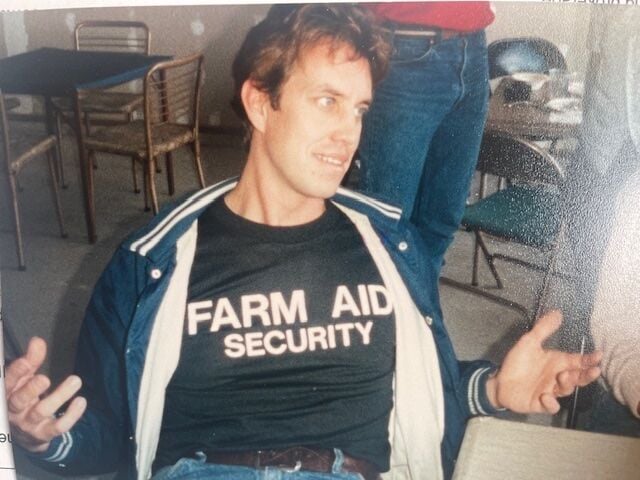
John Graham, circa 1985
The weather in Champaign on Sunday, Sept. 22, 1985, was cloudy with occasional light rain. Yet that soggy day had little effect on the spirits of 78,000 Farm Aid fans gathered at Memorial Stadium to witness history on stage.
They had endured long lines to get into the venue, long lines at the concession stands and what felt like even longer lines at the restrooms. It was worth it for something this special.
Around 3 p.m., through the mist, the a cappella harmony of “Ba Ba Ba, Ba-Barbara Ann” blew the clouds away, and for the next half-hour, it was sunny and warm. The Beach Boys were taking us “Surfin’ USA.”
That was one of my special memories from a memorable day. There were many others, including the twangy guitar intro of Roy Orbison’s “Oh, Pretty Woman” or the rebellious chant of Sammy Hagar declaring “I Can’t Drive 55.” With nearly 60 acts plus television and movie stars on the scene, this was an era-defining, Americana cultural event.
In 1985, Ronald Reagan was president. Bill Clinton was still governor of Arkansas and Louisiana Gov. Edwin Edwards was not yet in prison. Coca-Cola tried to change its formula to New Coke. Mike Tyson made his professional boxing debut, and “Back to the Future” opened in American theaters. Rock Hudson passed away and John Gotti orchestrated the rubout of mob boss Paul Castellano in front of Sparks Steakhouse in New York. And in July, Live Aid concerts in Philadelphia and London raised $30 million (about $90 million today) for famine relief in Ethiopia.
During the Live Aid concert, Bob Dylan mentioned from the stage that something ought to be done to assist American farmers who, after all, produce the food that helps feed the world.
A few days after Live Aid, Willie Nelson was on the road to a concert date at the Illinois State Fair. The idea of raising awareness of family-farm struggles had been on his mind for several years. Dylan had now mentioned it to the world. Word has it that a golf-course conversation between Nelson and Illinois Gov. James Thompson led to a larger discussion about a possible benefit concert for farmers, and thus the Farm Aid seed was in the ground.
The first Farm Aid was the largest, most successful of all the Farm Aids and remains one the greatest live events in the history of live events. Initially raising $7 million, the total is now over $70 million. How some of it came to happen in a short length of time and the behind-the-scenes hustling to get it done was where I came in.
For me, it all started five weeks prior to the show, on Interstate 57, cruising south out of Chicago.

Memorial Stadium was packed at the first Farm Aid concert on Sept. 22, 1985.
Sunday, Aug. 18
My wife and I were driving back early that morning from a friend’s wedding in Chicago when we heard on the radio that Nelson, John Cougar Mellencamp, Neil Young and Thompson were engineering a benefit concert for farmers. It was being billed as Farm Aid.
This was of interest and concern to me, as this show was to be presented at the University of Illinois’ Memorial Stadium on Sunday, Sept. 22. That was about a month away. A lot of work in a month.
I sensed that the Assembly Hall might have some involvement. Arriving home, I received a call from my boss, Tom Parkinson, director of the Assembly Hall. He said a meeting was scheduled for the next morning at the arena to discuss Farm Aid, and I needed to be there and get ready for something big.
Monday, Aug. 19
A small group of Assembly Hall team members gathered in the conference room, where Parkinson and UI Vice President Don Wendel informed us that we were designated by the administration to be the university representatives for Farm Aid.
The Athletic Association (now the Department of Intercollegiate Athletics) operated the stadium, and while they stated they would work with us on the event, their focus was football. With this concert in the middle of the season, their main concern was that the field and the facility didn’t get damaged by the show or the fans.
“If our field gets damaged a week before our game, there will be hell to pay,” claimed an athletic department representative.
I figured they might use Farm Aid as an excuse for losing a game.
The first Farm Aid concert at Memorial Stadium in Champaign on Sept. 22, 1985.
Tuesday, Aug. 20
Over 100 representatives from campus, local and state law enforcement and Champaign-Urbana stakeholders gathered at the arena to review and discuss the logistics for Farm Aid. Prior to the meeting, Parkinson asked me to prepare a sign-in sheet for the attendees. He also told me to watch for him to give me a quick nod when some of the individuals were speaking. I was to put an “X” by that person’s name.
As the meeting proceeded, some of the speakers expressed readiness and support for the upcoming event. Others complained about one thing or another. That’s when I would get the nod.
In total, roughly 70 percent got the “X.” The “X” group was not invited to the next Farm Aid meeting.
As Parkinson later explained: “We don’t have time to pick up stragglers.”

Watching from under cover at the first Farm Aid concert at Memorial Stadium in Champaign on Sept. 22, 1985.
Thursday, Aug. 22
Nelson was represented by the Buddy Lee Agency of Nashville, Tenn., and they enlisted the artists for the event. It was unclear who would provide the staging, PA and lighting.
The university would coordinate the crowd management, including police, parking, ticket-takers, ushers, EMS and the fire marshal. Many other agencies from across the state and city would be involved.
Ticketmaster and the Assembly Hall were assigned to sell the tickets. Prices were not set, but the thinking was under $25 (about $75 today).
Meanwhile, the Assembly Hall staff was working on the upcoming Tina Turner concert set for Sept. 10 at the arena. Turner was looking like an appetizer before the main course of Farm Aid.

Charlie Daniels performs at the first Farm Aid concert at Memorial Stadium in Champaign on Sept. 22, 1985.
Wednesday, Aug. 28
Tickets went on sale at 10 a.m. and the price was $17.50 each (about $50 today). All general admission, no reserved seating.
Ticketmaster had 70,000 tickets in its system, and 10,000 tickets were being sold at the Assembly Hall and the stadium.
Farm Aid continued to grow in size and nature. At first, the focus was primarily country music, but it expanded to include nearly all genres. Artists were being added on a daily basis, and with the announcement that The Nashville Network (now the Paramount Network) would carry the entire concert live, television and movie stars began lining up to be part of the event.
Reportedly, TNN was paying $1 million to Farm Aid for the broadcast rights. The rotating Live Aid stage used in Philadelphia was being transported to Champaign, and JAM Productions from Chicago would handle the overall production support for the event.
As of Aug. 28, the list of performers was a who’s who: Alabama, Hoyt Axton, The Beach Boys, The Blasters, Bon Jovi, Jimmy Buffett, Glen Campbell, David Allen Coe, John Conley, The Charlie Daniels Band, Lacy J. Dalton, John Denver, Bob Dylan, Joe Ely, Foreigner, John Fogerty, Vince Gill, Vern Gosdin, Arlo Guthrie, Sammy Hagar, Daryl Hall, Merle Haggard, Emmy Lou Harris, Don Henley, Waylon Jennings, Billy Joel, George Jones, Rickie Lee Jones, BB King, Carol King, Kris Kristofferson, Lone Justice, Loretta Lynn, Delbert McClinton, Roger McGuinn, John Cougar Mellencamp, Roger Miller, Joni Mitchell, Willie Nelson, Randy Newman, The Nitty Gritty Dirt Band, Tom Petty, Charlie Pride, Bonnie Raitt, Lou Reed, Johnny Rodriguez, Kenny Rogers, John Schneider, Brian Setzer, Southern Pacific, Sissy Spacek, Tanya Tucker, Van Halen, Dottie West, The Winter Brothers (Johnny and Edgar), X and Neil Young. Bruce Springsteen was scheduled to perform via video.
One word — HUGE.
This thing was happening and picking up speed. I felt like I was hanging on to a runaway tractor.

A fan above the crowd on the field at the first Farm Aid concert at Memorial Stadium in Champaign on Sept. 22, 1985.
Wednesday, Sept. 4
Nelson, Mellencamp, Young and Gov. Thompson held a press conference/farm leader meeting at the Assembly Hall that evening. Nelson was at the podium first.
He spoke briefly about the need for Farm Aid to raise money and awareness highlighting the plight of the American farming community. Some 120 family farms were going out of business every day, he emphasized. High interest rates and fuel prices were squeezing farm profits into the ground. In some cases, it was so bad, farmers were committing suicide.
Then Nelson began taking questions and suggestions from the farm representatives. He asked the press to leave the room so the farmers could speak more freely without the intimidating presence of TV news cameras.
His eye contact was focused and direct. It appeared to me, as he spoke to each person, he was speaking only to them, as if no one else was in the room. His voice carried surprisingly well without the need for amplification in a large room full of people. He listened to everyone who wanted to speak, no matter how long or how many.
Someone in the back held up a “Willie for President” sign.
After Nelson, Thompson stepped up to the podium. In my view, it was gutsy of the governor to speak to this group of angry, vocal farmers. Many stated that they were not interested in more aimless talk about government programs, heartfelt concern or words of sympathy.
Thompson took a lot of flak. Of course, the governor’s security detail was nearby. He handled it well.
After Thompson, Young got up to speak. Apparently, he had been taking notes. He provided a poetic recap of the discussion. He said something about the farmer and the honeybee feeding us all. The meeting broke up around 10:30 p.m., but not before Mellencamp declared: “The (expletive) government better get off its (expletive).”
Nelson, Mellencamp, Young and the governor moved to the main arena where the press had been camped out during the farmer meeting. Hundreds of press credentials had been issued. From local to international, all the major news outfits were there. They took a few questions and left the arena via the backstage tunnel.

Dancing in the rain at the first Farm Aid concert at Memorial Stadium in Champaign on Sept. 22, 1985.
Sunday, Sept. 8
Rumors were running wild about all things Farm Aid. Here are a few:
- Reagan was planning to attend, and protests and riots would ensue.
- Some 500 to 1,000 Hells Angels were going to show up. Allegedly, they followed Nelson wherever he went, and their favorite campground was the nearest country club golf course.
- A rival motorcycle gang, the Bandidos, was also on the way. Both gangs were going to roar into town, take over the stadium and engage in an epic brawl on the stadium floor.
- Some 1,000 Florida state troopers were being bused in to help local authorities with the crisis.
- There would be stampedes and riots when the gates opened.
- There would be fistfights over general-admission seating.
- There would be riots when the concession stands ran out of food.
- There would be violent altercations between the country-music fans and the rock fans.
- The loud music would create harmonic vibrations, causing the upper decks of the stadium to collapse. Tens of thousands would be crushed and killed.
- There wouldn’t be enough ambulances to carry the dead and wounded.
A staff psychologist with a local clinic called me demanding to know what contingency plans we had in place for the 150,000 people who were going to show up without tickets. He was adamant that their communal disappointment would lead to mass hysteria and a breakdown of law and order, with normally sane people committing insane acts.
He suggested that dozens of counselors were needed. I assured him that most people don’t go to events without tickets. Plus, it was on TV.
When I mentioned the mass-hysteria theory to Parkinson, he said: ”I’d be more worried about that guy.”
Tuesday, Sept. 10
The great Tina Turner. What a show. The saxophone player had his own fan club.
Wednesday, Sept. 11
Crews for ABC, CBS, NBC and other news organizations arrived by the hour. Each wanted the best location as if they were the only media outlet in town.
It was first come, first served. Some set up in the arena and others in the concourses. If they complained, they complained to each other.

Arlo Guthrie waits to perform at the first Farm Aid concert at Memorial Stadium in Champaign on Sept. 22, 1985.
Tuesday, Sept. 17
Preliminary construction of the massive stage began. It stretched wall to wall across the north end of the stadium. Steel beams and support girders were unloaded while stacks of plywood were positioned where the stage and sound towers would be built.
The top of the staging structure was five stories tall. On both sides of the stage were two video walls, each the size of a semitrailer. In fact, that’s what they were. The video units hinged in the middle and the top unit folded back on the lower unit, creating a Jumbotron television.
Huge rolls of thick field tarp were installed over the AstroTurf.
The uplink trucks for TNN, ABC and NBC arrived in the afternoon. Tyson Chicken trucks entered the backstage compound. John Tyson was in the lead truck and would supervise the cooking. Artists and crew were to be fed under long tents northwest of the stadium.
Flatbed semitrailers loaded with porta-johns rolled in. A mile of security fencing and hundreds of steel barricades were installed to create a perimeter for the backstage area. Forklifts zipped by at full speed and workers in Tyson caps were yelling all the time. Apparently, Tyson gave hats to the crew.
From the west-side sports box perched atop the stadium, the scene below reminded me of a giant ant farm. Looked like chaos, but it was working.
There were not enough taxis or limos in the Champaign-Urbana area to fulfill the transportation needs of crew and artists for an event of this size. A few vehicles were brought in from Chicago and Indianapolis, but we had to solicit private vehicles to take up the slack.
Our head car parker’s wife was a huge fan of Nelson’s, and when I asked her if she would be interested in driving him around for a few days, she threatened to punch me in the nose if I was joking. I assured her it was no joke. She was quite happy.
Years later, I attended her funeral. Her son told me that on one of the trips driving Nelson around, he left his wallet in the backseat of her car. When she returned it to him, he emptied the contents and gave her the wallet as a memento.
“I think Mom carried that wallet in her purse for the rest of her life,” her son said, tears forming in his eyes.
“She loved telling the Willie wallet story. I must have heard it 20 times myself,” he continued.
At the funeral, Nelson’s wallet was displayed, along with other memorabilia from her life.

John Fogerty performs at the first Farm Aid concert at Memorial Stadium in Champaign on Sept. 22, 1985.
Friday, Sept. 20
We reviewed the confidential door-opening sequence for Farm Aid with the director of the state police and representatives from the governor’s office.
Fans would line up on the east side of the stadium beginning after 10 p.m. Saturday. The public was advised that one set of doors on the south end of the stadium would open at 8 a.m. Sunday and that entry point was where the line would begin.
In reality, we would be prepared to open at 6 a.m. and instead of opening the south entrance only, we’d open all of the east side gates at the same time. The crowd pressure would be diverted from one direction to another, reducing pushing or running. This was the same plan used for a Springsteen concert at Soldier Field in Chicago.
The state police and governor’s office seem satisfied; I had the uneasy feeling that should something go wrong, a lot of fingers would point at the Assembly Hall management — especially the event manager. I couldn’t help but think about the hit TV show “The Fall Guy.”
Saturday, Sept. 21
Saturday and Sunday would be one long 48-hour day. So far, we had managed to keep fans from parking on university property or beginning to line up at the stadium.
Daryl Hall arrived late that afternoon to do a sound check. In the evening, as I walked to one of the production trailers, I saw three guys sitting on the steps of the trailer — Dylan, Reed and Petty.
They looked like a group of high school slackers smoking weed out behind the gym — except these slackers were part of one of the greatest art forms in history. Their music would continue to be heard for decades.
“Excuse me, guys,” I said, as I started up the step.
“Yeah, no problem,” Petty replied, as they angled to the side of the stairs so I could get by.
They were laughing and smoking pot or maybe cigarettes and seemed to be enjoying the scene. The Blasters were rehearsing on stage. Their high-energy rockabilly sound warmed up a cool evening.
For me, it was a late-night surreal showbiz dream. Bob Dylan, Lou Reed and Tom Petty. Really? They’re here and I’m here. Pretty cool world.
At 11 p.m., we began losing the parking areas. By midnight, fans were lined up at the east side gates.
Here we go.
Sunday, Sept. 22
Our usher and ticket-taker crews arrived at 4:30 a.m. Within an hour, the line stretched for six blocks, with the northern end fraying into three groups. Soon, the end of the line morphed into a blob and the police were requesting we open the gates.
At 7:05 a.m., the Farm Aid gates opened, and all went smoothly. No one rushed the field, no one fell, no riots, no mayhem. A portion of the line was moved to the west side by a lone security supervisor with a bullhorn — the Pied Piper of Farm Aid.
Some 10,000 fans oozed from the east to the west in a sea of blue jeans and baseball caps. By 10:05 a.m., the lines were gone. Anyone who wanted to be in the stadium was in the stadium. The show started as storm clouds rolled in. A light rain began to fall.
While I was walking through the backstage compound on my way to the catering tent, I met up with our rock doc. A local physician, he was often called to the arena to assist performers and road crews with health issues. Today, he was providing the same service for Farm Aid artists and staff.
As we walked and talked, a woman coming toward us smiled and spoke to the doc.
“You don’t remember me, do you?” she said.
“I’m not sure,” he began, tilting his head slightly.
As the doc was speaking, the woman lifted her blouse, exposing her breasts.
“Oh, yes, I remember now. Foreigner choir director, right?”
She nodded, letting her blouse down.
“They look like they’re doing great,” he continued.
“Yes, I think so, too,” she said, pausing, “Well, it’s good to see you. Hope you can catch our set later today.”
They exchanged a quick hug and the woman continued on her way. I was staring at the doc.
“Does that happen all time?”
The doc chuckled.
“She was the choir director for Foreigner when they played the Assembly Hall a while ago and she had a boob job sometime prior. I got a call from the promoter that someone needed to have stitches removed, and it was her.”
It’s only rock ‘n’ roll, I thought.
I stopped for an early lunch at the Tyson tent. Actress Debra Winger was seated next to me, and on the other side of the table were Johnny Cash and daughter Rosanne. Charlie Daniels stopped to say something to Cash and they both laughed at whatever Daniels said.
I was eating fried chicken and green beans at a superstar picnic. This will never happen again. None of it.
The day went relatively trouble-free with just two arrests, 20 ejections and a dozen ambulance runs. For a mid-sized city of 80,000 over a 14-hour time period, not bad. One poor guy got dumped over while in a porta-john. He was covered head to toe in yellowish-blue and brown goo. After plucking his wallet from the mess, he headed back to enjoy the show.
As night fell, the sea of fans, bathed in the lights from the stage, swayed to Young’s “Old Man.” It was mesmerizing.
Around 10 p.m., an ambulance roared up to the backstage area. My first thought was that someone on stage had been hurt or was ill, but then Sammy Hagar — The Red Rocker — leaped out of the ambulance and charged onstage to join Eddie Van Halen. This was Sammy’s first live performance with Van Halen, and they had the joint jumpin’.
Country fans and rock fans screamed together on the refrain to “I Can’t Drive 55.” Eddie’s wife, Valerie Bertinelli, was cheering and yelling. It was a loud crowd, and no one was leaving.
At 1 a.m., the stage was full of the day’s performers singing the final song — “Will The Circle Be Unbroken?” — followed by a traffic-stopping fireworks display.
An hour later, the stadium was empty with the exception of the stagehands and cleaning crews. The tarp-covered field was a swamp of debris floating in rain water.
Monday, Sept. 23
I woke up mid-afternoon not knowing how I got home. I didn’t remember getting in my car or driving to the house.
That was Farm Aid I. The first and greatest of them all.
[ad_2]
Source link

