
[ad_1]
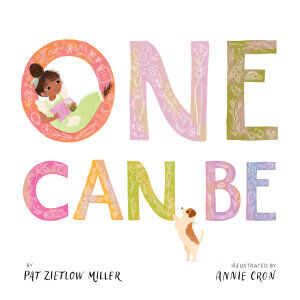
Pat Zietlow Miller, a bestselling and award-winning author, has published two books recently which address the same theme in two very unique ways.
- “One Can Be,” (2025, Beaming Books, illustrated by Annie Cron, ages 3-7) introduces us visually to a girl sitting alone in a tree, reading a book.
“One. Alone. No one else nearby,” we read.
We follow that character as she engages in other activities by herself — watering a tree, painting and singing, as the text tells us that one needs peace to breathe and grow, to think and know.
The playful vignette-style watercolor illustrations continue to develop our character’s story as she gazes longingly from her yard at the neighborhood children playing together, examines her big collection of books, and begins to build a little free library.
“One can create. Erase. And try again. Inside. Outside. Or even upside down.”
As we continue to turn pages, we see our character connecting with the other children.
“One. Misses friends. Now and then. So. One waves. And smiles. And connects the miles.”
The neighborhood children all work together to build and fill the little free library, as the text brings in ideas such as “teaches,” “shares,” “unites” and “cares.”
The book ends with a long shot of the neighborhood, showing everyone “Separate. But still very much together,” and “no longer far apart.”
- The power of one is also shown through a real-life example in Miller’s picture book biography, “Unstoppable John: How John Lewis Got His Library Card — and Helped Change History” (2025, illustrated by Jerry Jordan, Viking Books).
This book introduces us to former Congressman and author John Lewis as a child, saying, “All John Lewis wanted was a book. Actually, John Lewis wanted lots of books. Enough to fill a room and spill into the hall.”
However, John’s family couldn’t afford books, his school didn’t have many, and because he was Black in the 1950s, he was not allowed to have a library card.
Being denied a library card doesn’t stop John, however.
He sends a letter to the library letting them know he feels that they should lend books to everyone.
And when the library doesn’t respond to his letter, that doesn’t stop him either.
The book goes on to show the other obstacles faced by Blacks during that time period, telling readers that “John knew Black people should have the same opportunities as white people and that laws should never be based on race.”
John finds plenty of books to read at college and organizes nonviolent protests. The challenges they face are shown in the vibrant and expressively painted illustrations.
Still, none of these challenges stop John, and he continues to work for change through marches, protests and multiple arrests.
“Slowly, slowly, the laws changed,” we read … until finally, Black people could vote. And get library cards.
The book follows John into the political arena as he joins the city council in Atlanta and then the U.S. House of Representatives.
Finally, he returns to his hometown library, where he gives a speech to hundreds of people.
When he finishes the speech, “the librarians gave him a library card. Forty-two years after he’d first asked for one.”
An author’s note, timeline and bibliography complete this well-told story of a remarkable man who made a difference.
Alice B. McGinty (alicebmcginty.com) is the award-winning author of almost 50 books for children and runs a summer writing camp for teens, Words on Fire. She just celebrated the release of two books, ‘The Girl Who Named Pluto: The Story of Venetia Burney’ (Schwartz and Wade Books) and ‘Pancakes to Parathas: Breakfast Around the World’ (Little Bee Books).
[ad_2]
Source link

