
[ad_1]
Email nominations to rlecates@news-gazette.com
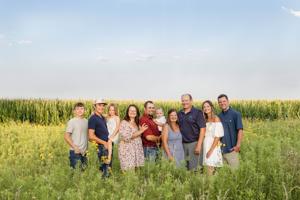
One of the most exciting things for Bernie Magsaman has been raising not only the family’s sixth generation of farmers but also the seventh.
His grandkids, both big and little, are already sprouting an interest in the family farm by wanting to spend as much time as possible there or participating in programs like FFA.
How long has your family been farming?
Farming has been in our family for many generations, even prior to immigrating from Germany in the early 1900s. Ever since then, each generation has continued the tradition. I grew up helping my dad and neighbors with farm work throughout my childhood and teenage years. A few years after college, I began farming with my brother on our home farm after my dad (Gilbert) retired.
Where is your farm operation?
Our farm is located near White Heath, but we farm in both Piatt and Champaign counties.
How and why did your family come to this area, and where did they come from?
My grandfather grew up in Iowa, but after the Great Depression hit, he moved to central Illinois to pursue opportunities to farm with family down here. Many years later, my parents met and settled near White Heath, where they raised seven kids and continued farming — and that’s still home base for us today.
What does your farming operation consist of? Is it strictly a grain operation, livestock or other?
On our farm, we grow corn, soybeans, wheat and hay. We grow commercial yellow corn as well as food-grade. Similarly, we grow commercial soybeans and non-GMO. We find that raising specialty grains help us capitalize on margin in times of tougher crop prices.
How many people in the family does the operation support?
Our farm supports me (Bernie), my wife, Lori, and our son-in-law Clint full time. Lori keeps everything running smoothly — from managing the books, running the grain truck and making sure everyone’s fed. Clint handles planting, grain hauling and the hay business.
It’s also been rewarding to see our high school/college–age grandsons take an interest in helping during the summer months — whether it’s walking soybeans or lending a hand wherever needed. Their involvement has even sparked their participation in FFA, which makes us proud to see that next generation learning and growing in agriculture.
How many generations of farmers are there?
While our kids are the sixth generation actively on the farm, it is exciting to see our now four grandkids becoming a part of the operation. Our 3-year-old grandson would prefer to spend every waking moment on the farm if he could. His excitement for the farm certainly keeps us driven to grow our farm for future generations!
Do you have any members of the family in the farm operation also working other jobs?
Our daughter Kaitlin works off the farm at a local ag lender, but she’s still very involved when she can be. You’ll often find her crop scouting on the weekends or in the tractor seat running the auger wagon during harvest.
Our daughter Megan doesn’t work on the farm day-to-day, but she’s still a big part of the family support system and enjoys helping when she can.
How have you seen farming change over the years?
Farming’s a lot different than when I started. The advancements in technology are fascinating. While we still use some of the old tractors on an auger or bailing hay — now, we’ve got drones spraying fungicide, GPS guidance and precision equipment. It lets us track field trials more accurately and create yield maps on the fly. It’s amazing to see how much farming has evolved in my lifetime, even down to the genetics in the seed we plant.
Your farm equipment: Green (John Deere), red (Case IH) or other?
We’re mostly a Case IH farm, but we like to keep things colorful — with a little green and even some blue in the lineup.
What makes farming such a good vocation?
I love being outside every day and working with my hands. Each day brings new challenges, which keeps things interesting. Farmers wear a lot of hats — from marketing to agronomy — I enjoy learning something new every year. There’s always something different to tackle, so you never get bored doing the same thing repeatedly.
What soil conservation practices do you employ on your farm?
Reduced tillage, no-till on erodible fields, cover crops and variable-rate fertilizer — it all just makes sense. We really like to do what works best for each field, because farming isn’t one-size-fits-all. Treating each field in a way that helps it produce the best crop, both agronomically and economically, is what guides the decisions we make.
If you could change one thing about farming, what would it be?
If I could change one thing about farming, it would be the uncertainty that comes with markets and weather. So much of what affects grain prices and our income is beyond our control — from unpredictable weather to global and political influences. That inconsistency makes planning and marketing crops a real challenge, and it’s one of the toughest parts of the job.
What’s the best time of year to be on the farm?
Spring is my favorite time on the farm. After the long winter, it’s great to be outside and see everything green up again. Spring is all hands on deck for us — we do all of our own spraying and enjoy the hustle of getting the seed in the ground. There’s a new sense of excitement that comes with each planting season.
Please list other areas of interest for your family.
Above all, we enjoy spending time together as a family. Farming keeps us busy, but it also gives us the chance to be active in groups and various boards in our community. At the heart of it all, we trust in God to guide the future of our farm and our family’s legacy.
[ad_2]
Source link


