
[ad_1]
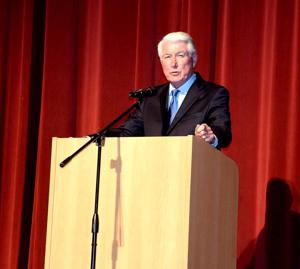
Back in the early 1970s — more than 50 years ago — Jim Edgar was perceived to be a young politician on the rise by those in Coles County and on the Eastern Illinois University campus.
Edgar was considered almost a political inevitability. So it was a surprise when, in March 1974, the 27-year-old lost a three-way Illinois House Republican primary race.
That was back in the days of cumulative voting. Edgar finished third (13,643 votes) in a five-county race, losing to another popular newcomer, Max Coffey (15,716), and veteran incumbent Rep. Chuck Campbell (14,789).
Decades later, reminiscing over lunch at Farren’s in Champaign, Edgar recalled every detail of that contest, citing results in a variety of precincts that cost him the seat.
Like a great baseball slugger, he never forgot his political statistics, especially in the only race he ever lost.
Edgar’s political journey came to an official end Sunday, when he died at age 79 from complications caused by treatment for pancreatic cancer. He announced he was receiving treatment for the especially virulent form of cancer earlier this year.
Despite that, he made public appearances in his final months, especially those to raise funds for his bipartisan Edgar Fellows program, designed to guide those active in government at all levels.
He’s now being remembered as the detail-oriented, cost-conscious chief executive who embraced the quaint concept that Illinois could not spend money it did not have.
For that, Democrats labeled him “Governor No.”
But Edgar’s fiscal prudence, not to mention his personal honesty, looks better and better with each passing year, given the imprisonment of two successors and ever-rising state debt.
“He knew state government better than any person who’s ever been elected governor,” said Al Grosboll, a longtime aide.
Grosboll said Edgar was motivated to “fix things and help people.” Given Illinois’ financial woes when he took office, big spending cuts were needed in some areas of the state budget to finance his priorities — public education and health care for those at the bottom of the income ladder.
As part of his governance style, Grosboll said Edgar went out of his way to recruit “very smart people” and was comfortable when they offered views different from his own.
One individual Edgar brought with him, Lt. Gov. Bob Kustra, credits Edgar for his very successful post-politics career. Edgar appointed Kustra to a dual role as chairman of the Illinois Board of Education.
“My term as chair went well and in ‘98 I was appointed to a university presidency which would then lead later to my Boise State years, the best of my career. … I will never forget how he was instrumental in sending me on my way to a most fulfilling second career,” said Kustra, who was president at Boise State for 15 years.
On the personal side, Grosboll said Edgar was “very smart, very well read” and an “introverted guy.”
Mike Lawrence, another top aide, said Edgar was determined to be “candid and forthright” with the public.
“He was not someone to change positions for the sake of expediency,” said Lawrence.
The public, obviously, grew to like and respect Edgar. His public approval record was sky high when he left office.
There was no guarantee at the beginning, but after Edgar’s initial electoral disappointment, his tactics and fortunes changed.
Edgar ran again for the Illinois House in 1976, after Coffey gave up his House seat to run for the Illinois Senate. Still young, Edgar was politically wiser.
“In 1974, when I ran my first primary race for state rep., I was chief aide to the speaker of the House, I knew the issues and understood state government. But what I found out the hard way is that you can know all the ins and outs but people want to know you, your family,” he said later.
Edgar moved quickly up the political ladder, leaving the Illinois House in 1979 to become GOP Gov. Jim Thompson’s director of legislative affairs.
When Democrat Alan Dixon vacated the secretary of state’s office after being elected to the U.S. Senate in 1980, Thompson appointed Edgar as Dixon’s replacement.
Like other secretaries of state, Edgar used the office platform to elevate his public standing. A teetotaler, he particularly focused on the public safety threat posed by drunk driving.
As a consequence, Edgar was ready to run for governor in 1990, when Thompson decided to step down after 14 years as governor.
He won a close race against Democrat Neil Hartigan.
The Chicago Tribune reported that Edgar’s “stable government through his reserved tone,” was a “ sharp contrast” to his predecessor’s “grandiose, free-wheeling personality bent toward spending, building and dealmaking.”
During his first term, Edgar confronted health issues that led to quadruple heart bypass surgery. After his release from the hospital, Edgar mixed humor about health and politics when he publicly thanked Democratic House Speaker Michael Madigan for the cheesecake, a tasty but artery-clogging dessert the speaker had sent him.
Despite that black humor sentiment, Edgar and Madigan worked reasonably well together, far better than Madigan had worked with other governors of both parties.
After overcoming his health issues, Edgar won a record re-election victory in 1994 over Democrat Dawn Clark Netsch. He even carried solid Democratic Cook County.
Edgar surprised many when, at 52, he declined to run for a third term. Despite constant overtures in future years, he never again sought public office.
Edgar said later that he didn’t understand why so many elected officials hang on so long, until it was his time to go.
Edgar said he broke down in tears as he rehearsed the speech announcing his decision to step down as governor. He said he “could not get the words out” because he was giving up “something (he) had worked for” all of his life.
[ad_2]
Source link
#Jim #Dey #beginning #Gov #Edgar #man #move


