[ad_1]
Drop in a question of your very own BY CLICKING HERE or by emailing Kathy Reiser at mailbag@news-gazette.com.
Whether a Champaign grocery store is soon to get a new name … where to find local performing-arts listings … a “farm of the future” in our own backyard … whether Urbana ever had a “Danville Road” … and a new chapel at a popular event venue. All in this week’s Mailbag.

“Rantoul’s County Market is becoming a Price Cutter. The County Market at Kirby and Duncan has become a Niemanns, and the County Market façade at Fourth and Stoughton has been removed. Is it being re-branded, too? Is the County Market name going away, all across the area?”
The City of Champaign issued a sign permit for the property at 311 Stoughton St. on June 24. The name of the business was recorded as “Niemanns.”
Gerry Kettler, spokesperson for the County Market grocery chain’s parent company, Quincy-based Niemann Foods, said the Stoughton Street store is being remodeled. He confirmed that, after the renovations are completed, its name will be changed to Niemanns to match the branding at the other Champaign store.
Kettler said the County Market brand will remain in place in many other communities around east-central Illinois

“The SW corner of Curtis and Race was recently fenced-in; it’s maybe a quarter-mile square. We saw some black Angus cattle in there for just a few days. What’s planned for that plot?”
Naveen Uppalapati, a research scientist with the UI Center for Digital Agriculture, said “we’re running crop-livestock integration experiments on 115 acres as part of the I-FARM testbed project. We’re tracking soil conditions, yields, water quality and animal health across nine different tiled plots. We also plant cover crops in with our cash crops and use them for grazing in late fall and spring, which helps cut down on feed costs.”

Described on the i-farm.illinois.edu website as “the USDA’s only farm of the future,” I-FARM stands for “Illinois Farming and Regenerative Management.” This UI-led study, funded for three years and $3.9 million by the USDA’s National Institute of Food and Agriculture (NIFA), is developing an 80-acre agricultural testbed in which commodity crops, cover crops and livestock are raised using synergistic, sustainable practices.
The I-FARM testbed “features improved precision farming with remote sensing; new autonomous solutions for cover-crop planting, variable-rate input applications and mechanical weeding; and artificial intelligence-enabled remote sensing for animal health prediction, nutrient quantification and soil health,” the website said.
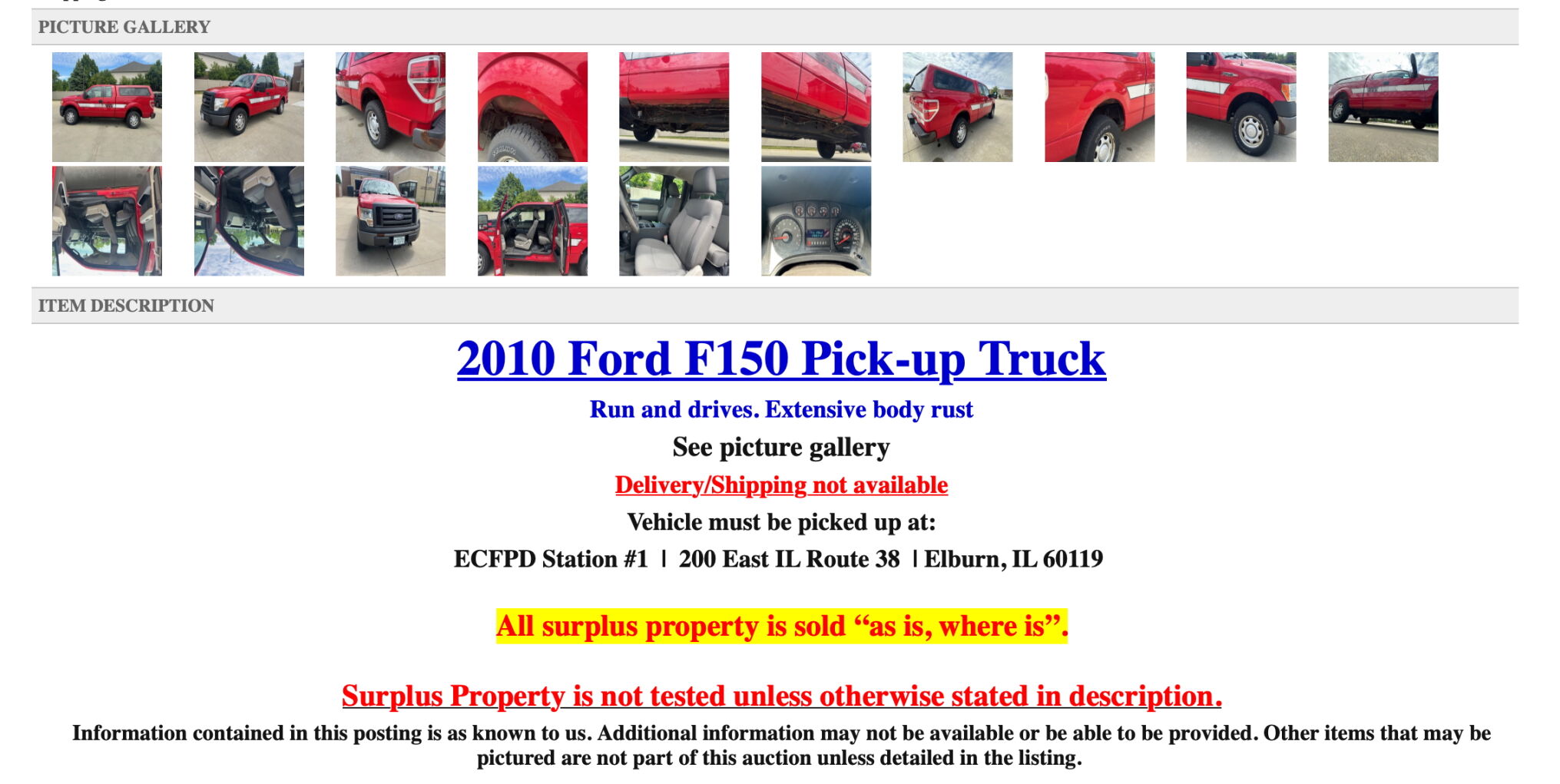
A pickup truck listing from the state’s iBid online auction site.
“How does the UI dispose of cars, SUVs and trucks from its fleet? Where and how are they sold when the University is done with them?”
The reader went on to say that most of the vehicles they see on the State of Illinois’ iBid website seem to be inoperable, heavily damaged, or “random vehicles such as buses or utility trucks.”
When university fleet vehicles reach a designated replacement period due to age, condition or mileage, they typically are traded-in to acquire new vehicles, according to UI Facilities & Services spokesperson Steve Breitwieser.
“That activity takes place through a group of university-approved vendors that provide separate price quotes for the vehicles, ensuring a competitive and transparent sales process whereby the university receives fair value. This method helps proactively manage and refresh the fleet, generally avoiding more significant maintenance requirements that occur later in a vehicle’s life cycle.”
As necessary and based on overall condition, Breitwieser said select vehicles may be transferred to the State of Illinois’ Central Management Services division as surplus property – and then auctioned “as is” on the iBid website.

“Where can I find a comprehensive listing of music, theater and other performances in C-U? With the paper coming in the mail now, I don’t always find out about them before they happen.”
The Experience Champaign-Urbana website, experiencecu.org, has an interactive calendar of events that is searchable by event date or date range, and by category. The categories include Arts & Theater, Music, Family-Friendly and several others. Many local venues and arts organizations post info on their scheduled performances there.
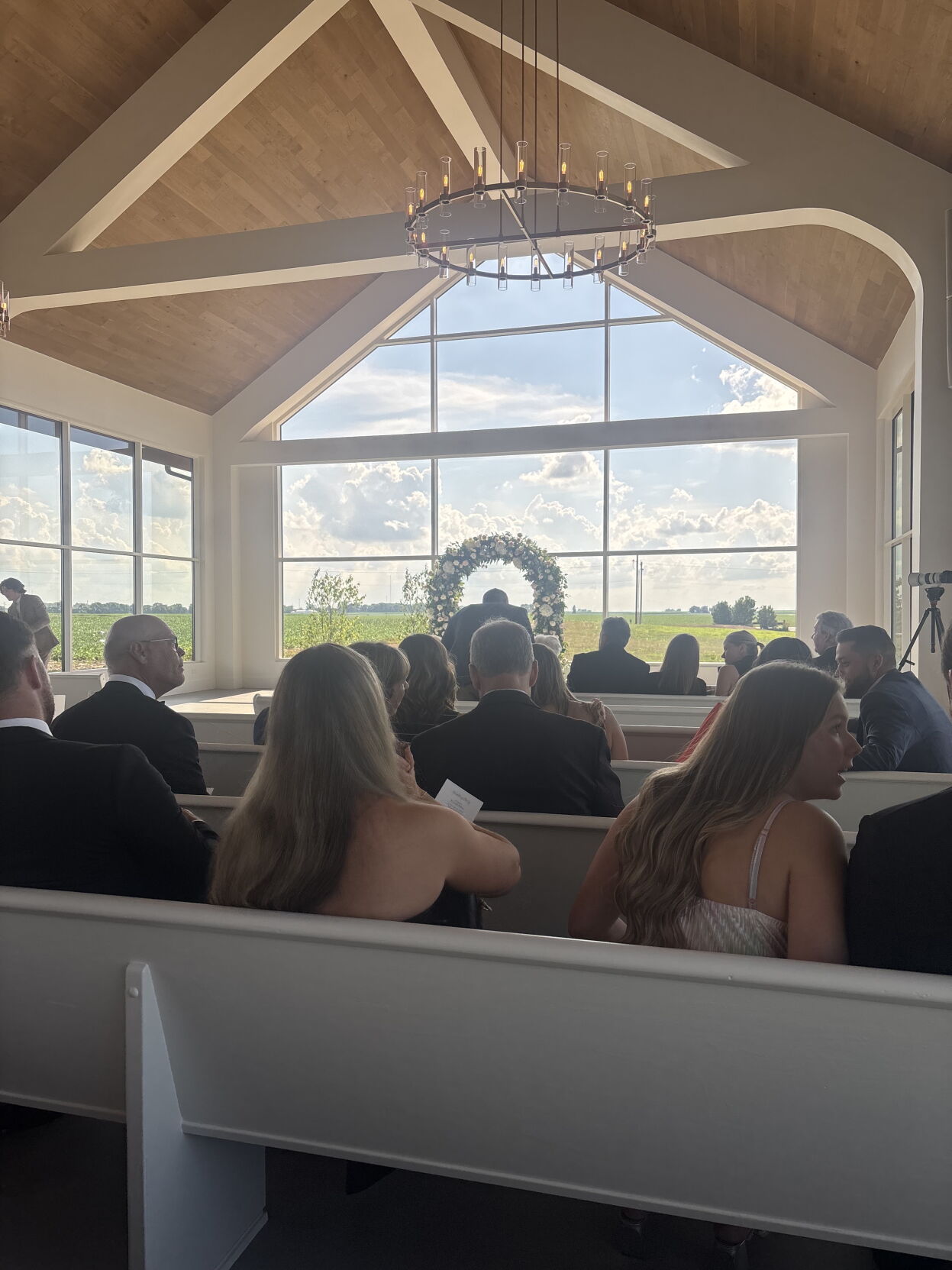
“Is that a new church I see at Pear Tree Estate?”
Not exactly. The popular event venue north of Champaign added its own wedding chapel just a few months ago. It’s located near the property’s entrance at 2150 County Road 1000 E in Champaign — a/k/a Way-North Mattis Avenue.
Pear Tree Estate’s website describes the complex as “a rustic modern event venue in central Illinois that can host events from 50-500.” Co-owner Lauren Murray-Miller said she and her sister Annie Murray Easterday added the new chapel because “we wanted to create a one-of-a-kind experience, a beautiful place for a wedding and reception. The chapel opened at the end of March and has already hosted many beautiful weddings and memorial services.”
The chapel seats up to 288 guests. Its pews are permanent and the space “is exclusively for events hosting receptions at Pear Tree Estate.” The full-service venue’s original building also is available for meetings, dinners and other events that require more, or more flexible, space. The sisters also operate L.A. Gourmet Catering.

“C-U has streets called Springfield Avenue, Bloomington Road and Philo Road, which presumably can be followed to Springfield, Bloomington and Philo. Was there ever a Danville Road?”
The Champaign County Historical Archives has an undated photo of a narrow, brick road identified as the Urbana-Danville Road. I don’t know whether the photo shows improvements to one of the earliest roads between Urbana and Danville, or if the pictured road was built in the early days of the automobile.

In the course of looking for something else in a local phone book from the 1950s — isn’t that the way it always goes? — I saw an ad for the Motel Mercer on Danville Road, Urbana. The motel’s address also was listed as 2210 E. University Avenue (U.S. 150) — right near the current-day Woodland Acres Mobile Home Community. So it appears local folks once did call that stretch of 150 “Danville Road,” even though no one seems to call it that anymore — perhaps because I-74 is now the main road to Danville from C-U.
As for the original Urbana-to-Danville Road … archives manager Pat Cain pointed me to a 1911 Journal of the Illinois State Historical Society article on the Danville and Fort Clark Road, written by Urbana judge and historian J.O. Cunningham. In the pre-automobile days, he wrote that a primitive road led “from the Indiana line near Danville, through the counties of Vermilion, Champaign, McLean and Tazewell, to Fort Clark, where now stands the City of Peoria, known in local parlance as the ‘Danville and Fort Clark Road.’”
Its course between the Wabash River and the Illinois River seemed to meander “from grove to grove and from timber belt to timber belt,” and provided access to the salt springs of the Vermilion River near Danville as well as the “salt works” that was set up there.
Within Champaign County, the original Danville and Fort Clark Road extended from the Mahomet area through Big Grove, a few miles north of the center of Urbana that we know today. East of Urbana, the original road dipped down toward the Salt Fork on its way to Danville; it does not seem to have closely matched the more direct routing of current-day U.S. 150/I-74.
Homer-area historian Ray Cunningham told me the original Fort Clark Road followed the timber line of the Salt Fork. “Roads typically followed the edge of the timber instead of going through wooded areas or out in the prairie — unless they were headed to a specific point, such as Hickory Grove. This was typical of early roads, which were not much more than paths from point to point. These points would be fords and ferries. Travel in the prairie by horse or wagon could be difficult due to mud or due to sloughs, a low, wet area that was generally muddy all year round. These could be depressions in the prairie long before drainage.
“When the road was surveyed there were no squatters or settlers along many stretches of the road. Subsequent parcels were sold on the road” as more white settlers moved to the area in the 1830s and beyond.
Fun fact: The reader’s question did not mention a Decatur Road, but I recently came across a 1920s newspaper ad that referred to Route 10 just west of Champaign as Decatur Road. Today, that stretch of highway is within the city limits — and we know it as West Springfield Avenue.


“Crews have gutted the old building at 64 Chester Street in Champaign. What did it used to be, and what are they turning it into?”
A City of Champaign building permit was issued on Sept. 20, 2024, for “renovation (of) existing 2-story storage to multi-family apartments.” The owner was listed as “64 Chester Street,” with a mailing address of 1612 S. Neil, Suite B — the same address as Cochrane Premiere Properties.
According to the LoopNet commercial real-estate listing for the property, the building dates to 1898. By 1916, it housed the Stoltey Garage; today, its south façade has a ghost sign for the Herrick & Stoltey Garage. Marshky Transfer Company was listed there in 1925, as was Sailors Rent-a-Ford System. Sailors also was there in the late ’20s and into the mid-’30s.
The 1938 directory shows “Bush Bros. (wholesale candy)” at that address. An invoice from the 1940s, found in the files of the Champaign County Historical Archives, says the company also supplied local businesses with soda fountain supplies, paper and paper specialties, janitorial supplies and school supplies. Bush Bros. was there until the mid-’90s. More recently, the C-U Mass Transit District owned the property and sold it in 2017.

“Two questions about the Second Street Basin: the goose droppings make the once-scenic walkways impassable at times. Also, the pond seems like it is rapidly silting-up. Any plans to dredge it?”
Champaign Public Works’ Kris Koester said “our Operations Division cleans goose droppings on a weekly basis at the Second Street Basin. However, the geese come back on (a) daily basis making cleanup an ongoing cycle.
“The city also is permitted by the Illinois Department of Natural Resources to remove goose eggs during the early part of nesting season; staff perform this activity at the Second Street Basin on an annual basis. We have employed other deterrents throughout the city at our detention basins and continue to look for other legal means of deterring them.”
He said the city’s Environmental Engineering Section is aware of the siltation at the Second Street Basin and is developing plans to remove the sediment and designing measures to slow down future sedimentation into the basin. “We tentatively plan to complete design of the project in 2026 and perform construction in 2027. The project timeline has some uncertainty due to multi-jurisdictional permitting from the Army Corps of Engineers, Illinois EPA, Illinois Department of Natural Resources and other governing agencies.”

”Are there plans for the parcel of land at the NE corner of Mattis Avenue and Old Church Road in Savoy? A large area has just grown wild with shrubs, trees and grasses.”
A large portion of the property was developed into Liberty on the Lake subdivision several years ago. The owners of the remaining acreage do have plans for it, but there’s no word on when those plans might be implemented.
Dan Hamelberg, chairman of the University Group, said “we have 73 acres available starting on the NE corner of Old Church Road and Mattis and running east along the north side of Old Church Road until you see farmland. There is a plan for about 200 home sites for the property, but it could actually be divided up and developed in stages as well.”

“There’s a dry basin along North Prospect Avenue, north of Interstate Drive, that is full of vegetation and plastic grocery bags. Does the city require neighborhoods to clean up and maintain their detention basins?”
The property owner is responsible for the maintenance of detention-basin areas, said City of Champaign Code-compliance Officer Tim Spear. The basin mentioned by the reader is owned by the adjacent neighborhood homeowners’ association.
“I believe the south part of the basin continually holds water and the north side is normally dry. I know of at least two cleanups that the neighborhood has done on this area so far this year. The area gets a lot of wind-blown litter since it is so close to the commercial area, so it is a recurring issue.”
It can be a losing battle, but he says “the neighborhood group has been doing what they can to maintain the basin areas.”
Fellow local history buffs, a quick promo for two brand-new exhibits that open this evening at the Champaign County History Museum. An open house is set for 5 to 7 p.m. to introduce exhibits on:
Sadorus native Dorothy “Dottie” Schroeder’s monumental career in the All-American Girls Professional Baseball League. Learn about the four teams she played on during her 12-year career, see artifacts from her years in the league, and more. If you’re also a movie buff, you probably know the feature film A League of Their Own had a lead character based on Dottie; Geena Davis played her in the movie.

Pioneers of Radio. Explore the role of radio in the American home and how the technology and its role in society evolved right here in Champaign County. Exhibits trace histories of local radio stations and on-air personalities.
The museum is at 102 E. University Ave. in Champaign — in the historic Cattle Bank building. If you can’t make it to the open house, catch the new exhibits during the museum’s regular business hours on Saturdays (10 a.m.-5 p.m.), Wednesdays (1-5 p.m.), Thursdays (1-7 p.m.) and future Fridays (1-5 p.m.).
[ad_2]
Source link

