
[ad_1]
To submit a letter to the editor, click here.
To pitch a ‘My Turn’ guest column, email jdalessio@news-gazette.com.
Want to purchase today’s print edition? Here’s a map of single-copy locations.
SAVOY — Residents who live near the site of a planned rental housing project near a proposed downtown square have come out against a proposed rezoning for the property, saying they fear it could open the door to more intense development if plans change.
“What’s to say that they don’t sell this property tomorrow and put up a three-story residential multi-unit high-density apartment complex?” local lawyer Cristina Manuel said at a recent meeting of the village’s planning and zoning commission.
Flippin Fabulous LLC, managed by Marissa Siero and Rhiannon Clifton, is seeking to rezone 201 and 205 W. Church St. from Moderate-Density Single-Family Residential District (R-2) to High-Density Multi-Family Residential District (R-5).
“We would like to increase population density in that area, but in a really responsible and respectful way for the community,” Siero told The News-Gazette.
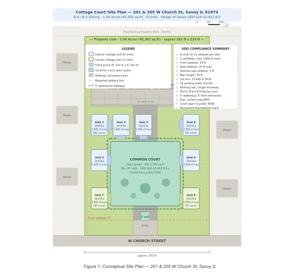
The plan is to combine the two lots on Church Street and build a cottage court, which is defined by the village’s unified development ordinance as “a group of small-scale, detached dwelling units located on a single lot or individual lots and arranged around a shared court visible from the street.”
The two properties are located south and west of a site where village officials are working with Downtown Development Group, which is led by Siero, to create the downtown square.
Siero said the vision is to build about eight two-bedroom, two-bathroom homes, which are currently projected to rent at about $2,000 per month. Under the ordinance, the floor area for each home in a cottage court is capped at 1,800 square feet.
There is currently one single-family home on each lot, and both of these are being rented out, Siero said.
She added that, depending on the condition of the homes at the time of development, they could be incorporated into the project rather than demolished.
“We would have the option to work with our current tenants if we wanted to start the infill development towards the back of the property, working our way forward,” she said.
“We do have tenants in both properties until about this time next year. We would never want to disrupt their lives to the point where they’re not having a good experience. So it’s working with our tenants to see if they would be comfortable with the development. Or we would plan for the development to occur at the end of their leases.”
Several neighbors spoke at the planning and zoning commission’s April 20 meeting and others wrote letters urging it not to rezone the properties.
Manuel feels that the village should encourage “more homeownership, not less.”
In addition to apprehensions about a high-density development being located next to single-family homes, community members also expressed concerns about traffic, noise and crime.
Diane Ditzler feared that the rezoning and other development in the area would drastically change Savoy’s peaceful, small-town atmosphere.
“We don’t need to become the big city of Savoy,” she wrote in a letter to the commission. “What we don’t need is to become (a) noisy, unsafe, possibly drug-infested draw to everyone.”
Siero said that it is not her intention to “overdevelop” the site or do anything that would be a detriment to residents’ quality of life.
“There’s a really strong neighborhood feel that is old-town Savoy,” she said. “So rather than putting in, let’s say, a high-rise or an apartment building, the cottage court allows us to achieve higher density but also has the look and the feel of a nice transition from a single-family home on an R-1 (Low-Density Single-Family Residential District) or an R-2 zoned property into an R-5.”
She added that when it comes to concerns such as traffic problems, crime or lower property values, such impacts are “very much the opposite of what we’re hoping to do.”
Additionally, Siero said the project aims to help fill in the “missing middle” when it comes to housing. Target demographics include individuals who are downsizing or are in need of a stepping stone before becoming a homeowner.
“Perhaps they’re looking for temporary housing before they buy their forever home, or perhaps they’re pre-tenure with the university,” she said. “This gives them a chance to really get to know our community before necessarily coming and buying right away.”
The planning and zoning commission has recommended that the village board approve the rezoning, and the item will be discussed at the board’s May 6 study session, Siero said. No formal action is taken at study sessions.
It’s her hope that as she continues to share the plans, people will change their mind about the project.
The commission is also recommending approval of a separate request by Grit & Grind Ventures LLC, managed by Marissa and Adam Siero, to rezone nearby 206 Wesley Ave. from R-2 to Downtown District.
Siero wrote in her application that rezoning 206 Wesley Ave. “will allow for greater long-term flexibility consistent with the property’s proximity to the downtown area and nearby commercial uses” but does not require any “immediate change” to the current single-family use of the property.
“In the (village’s) comprehensive plan, there is an overall possible vision of continuing the downtown, and that could include either mixed-use buildings or high-density apartment buildings,” Siero told The News-Gazette.
However, she added that she doesn’t want to “oversaturate” the area and will first see how the initial downtown square project progresses over the next year.
“Most likely we will have (206 Wesley Ave.) rezoned and then we will continue to monitor what the needs of the community are before we would put forth a proposal to break ground and develop that lot,” Siero said.
The Wesley Avenue site is located in the village’s downtown tax-increment-financing district; so is 201 W. Church St., but not 205 W. Church St. The TIF district is a tool that the village can use to incentivize redevelopment.
[ad_2]
Source link

