
[ad_1]
CHAMPAIGN — Incorporating artificial intelligence into any industry has its challenges — accuracy and data protection, to name a few.
For the Brunswick Corporation, however, there are some additional hurdles.
“When you’re out boating, you kind of want to be out boating,” said Jeffrey Reifsnyder, director of the company’s Boating Intelligence Design Lab, based at the University of Illinois Research Park. “You don’t want to be worried about whatever’s going on. You don’t want to be looking at your phone, typically. You’re out there to get away from it all.”
Boaters typically “don’t want their technology to be in their face,” he said. Consequently, verbal communication from an AI agent isn’t likely to be popular with Brunswick’s customers.
On the other hand, a “multimodal agent” that can communicate verbally but also has other methods of receiving and sharing information might be more desirable.
“And that’s the space that is kind of uncertain,” Reifsnyder said. “We don’t know how that’s going to look. So there’s a lot of playing in that space that’s happening in the lab.”
The design lab, formerly known as Illini Joint Explorations in Technology, or “i-Jet,” tries to look three to five years into the future and plan for Brunswick’s needs, he said.
“The idea of ‘boating intelligence’ is meant to be more expansive than just artificial intelligence,” he added. “It’s meant to sort of say, ‘We’re trying to bring modern technology to play in the boating space.’”
The lab also serves as a recruitment center.
“The students are our primary resource for a lot of the work that we do,” Reifsnyder said.
He explained that, as director, he has about five or six full-time employees who report to him and are each responsible for “a certain umbrella of technology.” These employees, in turn, recruit students to work for them as interns and support their respective focus areas.
One such intern is Prathik Srinivasan, who is in the UI’s computer-science program and will graduate in May with a master’s degree. He has primarily worked on the development of “immersive simulators” during his time at the lab.
“I have really loved being given the chance to explore a large variety of projects and technologies, and to have my work showcased in a meaningful way,” Srinivasan said.
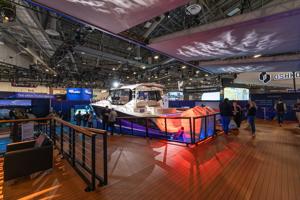
A group of student interns from the lab, including Srinivasan, attended CES last week in Las Vegas, where they helped set up Brunswick’s exhibit and present it to visitors at the show, Reifsnyder said.
“The interns that we brought with us did a phenomenal job,” he said. “The Brunswick booth was perpetually busy, and the simulators that the students worked on had a significant chunk of the foot traffic stopping at their areas. The students handled themselves well through all of it.”
Brunswick officials said the company’s exhibit included:
- A 200-degree virtual boat helm simulator to show how an “AI-powered co-captain” might aid boaters in the future.
- A Fliteboard simulator that let visitors get a taste of what it’s like to ride the company’s electric hydrofoil.
- The latest development version of the company’s autonomous docking system, “both virtually in a 200-degree simulator and physically on a 40-foot Boston Whaler 405 Conquest.”
- A concept for a high-powered electric boat.
According to Reifsnyder, the Future Helm and Fliteboard simulators “were almost entirely developed by students.”
“They’re acting as kind of every stage of this in my mind,” he said. “The ideation, the development and the showcasing of these ideas are all coming from and with the students. That’s not to say that it’s only the students, by the way. It’s the students in conglomeration with the various different divisions of the company.”
Srinivasan said it was “really rewarding” to see thousands of people visit their exhibit and try out the simulators.
He was the primary designer and developer for the Fliteboard simulator and also contributed to the user interface and “back-end programming” of the Future Helm simulator.
“The reception was super positive from both everyone at Brunswick and from all the attendees, so I am super proud of what I and the rest of the team were able to accomplish,” he said. “It was also awesome to see all the innovative new tech presented by other companies, and I’m excited to see what the future holds for the automotive industry.”
As for the future of the boating industry, Reifsnyder said that Brunswick has been working for several years to find ways to “leverage” AI and data science on the production side of things.
However, one of the more visible ways customers might first see AI incorporated into boating technology would involve taking information that is already collected by the boat’s systems and communicating it to users more effectively.
“An example that I can talk about, because there are other companies already working in this space, is radar,” Reifsnyder said. “So radar’s not necessarily an intuitive user interface right now. You get some blips on a screen, and you’re trying to guess, ‘What is that thing? Where is it?’”
However, he noted that if Brunswick decides to incorporate AI into its boating products, it will be important for the company to be “transparent” in how the technology is used.
Protecting consumer data is also a concern. For instance, he said that they do not want to risk a boat’s location data getting into the wrong hands, as this could lead to theft.
“Some of those aren’t necessarily AI problems,” he added. “Those are problems that come with connectivity. So as soon as you get wireless connectivity on a boat, all that data is generally available, AI system or not. So how do you make sure that that data is safe and protected?”
He added that incorporating AI raises the question of whether data is being stored locally or on the cloud and, in either case, how secure it is.
[ad_2]
Source link


