
[ad_1]
Want to purchase today’s print edition? Here’s a map of single-copy locations.
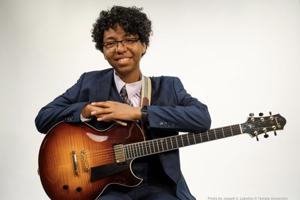
Showtime at Krannert The Marel Hidalgo Quartet is set to take the Krannert Center stage Thursday, part of opening night of Ellnora: The Guitar Festival. The event kicks off with the performance of the national anthem by another teen musician and her band, Grace Bowers & The Hodge Podge, at 5:15 p.m., followed by the Marel Hidalgo Quartet at 6:30 p.m., Bertha: Grateful Drag at 7:30 p.m., and the Messthetics and James Brandon Lewis at 8:30 p.m. The festival runs through Saturday, with a mix of free and ticketed performances across a spectrum of musical genres.
URBANA — Marel Hidalgo was first inspired to pick up an instrument at the tender age of 4 after seeing a cartoon dog playing the guitar on PBS Kids.
Soon after, he began taking guitar lessons at a local music store after proving that he could place his small fingers on the proper frets and pay attention well enough to take instruction. Less than two years later, he made his professional debut.
Now 17, his resume includes performances at the Rock & Roll Hall of Fame in Cleveland, Jazz at Lincoln Center in New York City, the Sunset-Sunside Jazz Club in Paris, Teatro Nacional de Costa Rica and the New York Guitar Festival.
On Thursday, he can add the Krannert Center for the Performing Arts to that list. The Marel Hidalgo Quartet will be in town to help kick off Krannert’s 2025-26 season on the opening night of Ellnora: The Guitar Festival.
“The best part (of playing live) is the fact that you’re playing for other people. Sure, they’re clapping for you, but I think music has an impact on people as a whole,” Hidalgo says. “Someone could have a long day at work, but the music really changes how you feel about certain things. It’s also a service to people. You really gotta share the music for it to matter.
“They personally came out here to see us play,” he says. “We try to … send them home with something they’ll remember. That’s really the goal with me when it comes to performing.”
How it began
Hidalgo took formal lessons for about eight years and credits his guitar teacher with giving him a solid musical foundation and his parents for supporting him throughout his journey.
Now, though, he hones his skills playing jazz clubs and festivals in the United States and abroad. His visit to Urbana this week will be the last stop on his current tour, and he plans to hang out for the weekend, sharing Krannert’s green room with a wildly talented pool of guitarists.
While Hidalgo will be playing music with a jazz flair, it’s not the only type of music he plays, and he doesn’t want to be defined by it.
“Even though people call me a jazz guitarist … I wouldn’t say it’s completely true,” he says. “It is very much so a part of what I play, but I don’t want to pigeon-hole myself into one thing.”
For the first few years of his career, he dabbled in a variety of genres, from blues to progressive rock to reggae. He effortlessly performed guitar solos by the likes of Prince, Santana and Joe Satriani. Then, a couple years ago he became interested in jazz.
“It was quite the change from … the music that I loved,” says Hidalgo, whose fascination with jazz came during a period of transition. His band members were retiring or heading off to college, which made him think it was time to try going solo.
Broadening his horizons
“Somebody told me to check out (jazz guitarist) Joe Pass. That’s really how I heard about jazz to begin with,” he says.
Then he started playing with other musicians and he rediscovered Ernest Ranglin, a pioneering Jamaican guitarist whose music he first heard as a 5-year-old.
Ranglin, says Hidalgo, is a “notorious session musician” who played with reggae superstars Jimmy Cliff and Bob Marley.
“Most of the songs that you’ve heard that are reggae, he was either arranging it and playing guitar on it or had a very heavy role in it,” he says.
Despite his reputation as a reggae musician, it turns out Ranglin also has jazz chops.
“I found out that he was originally a jazz guitarist — a really remarkable one — so I sort of kind of also got more into jazz thanks to him,” Hidalgo says.
When Hidalgo and his quartet perform at Ellnora, they will be playing a set list that is an homage to the 93-year-old Ranglin. The performance, says Hidalgo, will be “a big celebration of his impact on music as a whole.”
It’s all music composed or arranged by Ranglin as well as traditional Jamaican music with calypso.
“Even though it’s not exactly jazz, there’s a very heavy influence,” Hidalgo says. “It’s basically reggae, ska and calypso with jazz inflections in it. The drums are playing reggae, the bass is holding down the reggae bass line, the piano is holding down the beat as well. But what we do on top of that leans more toward jazz with the rhythm of that Caribbean music, which is something Ranglin is really the master of.”
Playing jazz and reggae keeps things fresh for Hidalgo. The improvisational aspect of the two genres keeps him and his band members from tiring of the music, even if they are performing the same songs at multiple stops on a tour.
With reggae, “the groove is always going to be there,” he explains, but the nature of the music allows for “different ideas” when playing live. “One song could last either five minutes if you’re on a schedule, or it could last two hours because it’s like a trance sort of thing.”
A musical conversation
The same can be said for jazz.
“It’s a really big conversation,” Hidalgo says. “We’re (the band) just paying attention to what everyone is ‘saying.’”
It’s not exactly free jazz since all the musicians usually know what chords are going to be played, but there is still a lot of latitude, he says: “It always works out.”
“There’s no wrong way to have a conversation,” he emphasizes, “except if you’re not listening. If you ask me a question and I completely ignore it and I start talking about how the weather is in Timbuktu, that wouldn’t be a very productive conversation. As long as you listen in this music, everything should end up making sense.”
Listening is also important when learning the ins and outs of jazz musicianship, Hidalgo adds.
“I listen to a bunch of records and a bunch of albums, and just listening to how someone plays a tune … it’s the same way children learn how to speak,” he says. “They’ll first begin to imitate what they see their parents do and then they’ll start to understand words and put together sentences and within time, they’ll be as fluent as they can be.
“My first guitar teacher, he really was the one who put it in my head that reading music is good, but you know, learn stuff by ear, nail stuff down note by note before you say you know it.”
While Hidalgo is already quite accomplished on the guitar, there’s always room to learn more, especially in the jazz realm. One of the best ways to learn, in Hidalgo’s opinion, is to sit and play with other accomplished musicians.
“I’ve had the opportunity to play with a lot of really great jazz legends,” he says, “and every single song you play with them is a master class in and of itself since there’s so much going on. Jazz is a really interactive music that whether you like it or not, every single gig and every single concert you do, you’re going to learn a few things off of it.
Interactivity also defines one of the lessons he’s learned along the way, which is to value the wisdom and life experiences of other musicians he encounters.
“They might not be better than you and you might not be better than them, but they know something you don’t and you’re going to know something they don’t,” he says. “So, if you keep your ears open, you’ll probably catch just about everything you need to catch.”
Learning from others is just one part of his growth as a musician, however. Another is the value of practice.
“It really is a lifelong process,” he says.
He recalls hearing the story of a seasoned cellist who was asked why he still practiced so much despite being a long-time member of a renowned orchestra. The cellist’s answer: “Because I think I’m making progress.”
Hidalgo’s takeaway: Don’t be so ego-driven that you don’t think you need to practice.
Becoming an accomplished musician is a multi-faceted endeavor, based on Hidalgo’s experience thus far. From learning the value of practice to having conversations and jamming with other musicians, Hidalgo appears to be well on his way.
“There’s room for everything,” he says, “but when it comes to jazz, I’d have to say most of it comes from ‘What did you learn on the bandstand?’ and ‘What did you learn from listening to people?’”
[ad_2]
Source link


